
Bundeswehr exercises
Whether at the garrison range or at the training area with NATO partners, the name of the game is being able to fight so we won’t have to fight.




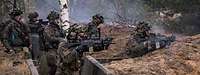
Whether at the garrison range or at the training area with NATO partners, the name of the game is being able to fight so we won’t have to fight.
Credible deterrence and effective defence require mission-ready forces that can perform their mission sustainably. Military exercises are needed in order to train the necessary capabilities, from deployment to high-intensity combat, from planning and securing supply lines to planning and conduct of operations in the division staffs.
Russia’s war of aggression against Ukraine has shifted the focus back to exercise scenarios for national and collective defence, after decades in which the Bundeswehr’s training and exercises were primarily oriented towards missions abroad in conflict and crisis management.
Shifting the focus back to national and collective defence does not change the fundamental capabilities needed or the military skills involved. “Reconnoitring, antiaircraft defence and camouflage, defence, delaying operations and attacking – that has always been covered by training and exercises”, explains Lieutenant Colonel (GS) Markus H., desk officer for military exercises in the Directorate-General for Forces Policy (now the Major Directorate-General for the Armed Forces) at the Federal Ministry of Defence. “But the priorities and intensity are different”.
Only by practising for an emergency can we fulfil our defence mission in an emergency.
In preparation for an operation abroad, he explains, a military unit conducted exercises for certain capabilities for a clearly delimited mission in a specific security and geopolitical environment. By contrast, an emergency in national and collective defence would involve all available forces. The exact area of operations is unclear – we only know that it would be somewhere on NATO territory. And our potential adversary has armed forces on a par with ours in terms of size, capabilities and equipment, unlike the irregular adversary forces on operations abroad in recent decades.
The activities are also on a different scale: The focus is on combat in units of brigade size or larger instead of subunits. “In conflict and crisis management, there are no division staffs that command and control thousands of military personnel in large-scale, highly mobile combined arms combat. That’s a capability we haven’t needed for a long time”, says H. All domains are also involved. This means that, in the event of an Article 5 contingency, defence would combine activities on land and water, in the air and in cyber and information space.
Nevertheless, H. points out, many things have changed since the Cold War: “Germany is no longer a frontline state. Our mission is collective defence – much like that of the Western allies before the collapse of the Warsaw Pact”. As H. sees it, that is why we have to rethink national and collective defence and redesign our exercises – including the multinational level. “No European country has enough military assets to be capable of defence on its own for a longer period of time”, says H. “Effective defence is only possible in an alliance”.

A Fuchs armoured transport vehicle in a front garden: Shifting the focus back to national and collective defence means more military exercises in public. Here, a Bundeswehr member in a Fuchs armoured transport vehicle monitors part of the road.
Bundeswehr/Mario BährShifting the focus back to national and collective defence also means that the armed forces will once again conduct more exercises in public spaces. This particularly applies to logistics. Deployment exercises through Germany and European NATO territory into a potential area of operations – whether by land or sea, by rail or air transport – inevitably take place in civilian environments. At the same time, exercises must also be conducted on using civilian infrastructure, for example when tanks are repaired in truck repair shops during exercises.
The flexibility and mobility requirements are also increasing. In national and collective defence, all forces must be able to adapt to quickly changing situations – the combat force as much as the supporting forces. H. emphasises that: “The important thing is to get combat-ready fast in any situation and any terrain, while also being able to provide supplies as seamlessly as possible. That means: improvising and doing without instead of going for perfectionist solutions and comfort”.
Where does the Bundeswehr actually conduct exercises? Why do military convoys only ever drive past my home at night? And can’t the Bundeswehr just do its exercises at training areas? You can find answers to these and other questions here.
There are three main types of exercise: wargaming, command post exercises and full-strength exercises. Full-strength exercises generally involve all the military personnel in a military unit, including supporting forces such as Medical Service, IT and logistics personnel. The purpose of the exercise is to train seamless cooperation of all military forces – lines of supply and communication, medical care, military command and control, and of course the actual combat. Not only permanent units, but also formations that are assembled for specific missions – such as the VJTF – perform full-strength exercises, which can involve thousands of military personnel.
In command post exercises, only the staffs of a unit are trained. The focus is on reinforcing and optimising command and control processes. Command post exercises are often integrated into larger exercises or held in advance of them. In order to strike a balance between realistic timelines and efficient use of exercise time, simulations are often used for this purpose. In addition to combat exercises, full-strength exercises also always include command post exercises.
Unlike these exercises, wargames are tabletop exercises without real troop movements. They allow reflection on and detailed planning of both individual operations with clearly defined objectives and complex scenarios with global implications.
National and collective defence generally requires the same military capabilities as international conflict and crisis management, albeit with different priorities. However, there are differences in the missions, adversaries and scale, and therefore the complexity and scope of the exercises.
If the Bundeswehr is deployed in international conflict and crisis management, the mission mandate and mission country are clearly defined. The unit deployed conducts exercises to prepare for specific threats in a specific environment. In this process, it goes through various phases – preparation for deployment, deployment and post-deployment activities – and achieves its highest level of training during the deployment abroad. By contrast, national and collective defence is an ongoing responsibility. Accordingly, it is important to consistently conduct exercises in order to maintain the level of training achieved and consolidate it even when there are changes of personnel.
The potential adversaries are also different. International conflict and crisis management is characterised by irregular forces, sometimes with changing structures, unlike national and collective defence, which involves confrontations between professionally operated armed forces whose capabilities, equipment and size are more or less on a par with each other.
In addition, national and collective defence must be considered on a different scale. For example, the most extensive Bundestag mandate for Afghanistan included around 5,300 Bundeswehr military personnel, while the VJTF alone – only the spearhead of the NATO Response Force – already includes some 10,000 military personnel. And the VJTF forces would only be the first multinational troops on site in the event of an attack on a NATO country. As a first step, they would then be followed by reinforcement forces from the NATO Response Force and NATO members.
What is more, national and collective defence takes place in all domains – on land and water, in the air and in information space. It requires highly operational forces that consistently conduct exercises under realistic conditions, including regular exercises in large units, in their mission area: the country they are defending.
Hundreds of Bundeswehr exercises take place each year, the vast majority of them at training areas. However, certain tasks and processes can only be practised as free-play exercises, i.e. outside of Bundeswehr sites. For the Navy and Air Force, the exercise areas result from their mission of protecting sea routes and airspace – usually outside of training areas and in keeping with the principle of “train as you fight”.
However, the Army and the Joint Support and Enabling Service also conduct exercises in public spaces. For example, land navigation, road movements and deployment of military forces by rail, ship or aircraft can only reasonably be performed outside of training areas. This also applies to surveying and use of civilian sites for military purposes, e.g. in exercise scenarios for national and collective defence. Even training and practice for individual Bundeswehr members’ capabilities and skills sometimes require a different terrain than the training areas can offer, e.g. for parachuting, crossing unknown bodies of water or rappelling into crevasses in glaciers.
Virtual training and simulators are also an integral part of the force’s range of training and exercises – for easy adaptation of training scenarios, for drills of procedures and for resource and cost reasons, for example in training Eurofighter pilots or gunners in battle tanks. Nevertheless, simulators have their limits. Whether planned processes and practised capabilities work in real life – to put it simply, whether the gunner can still reliably hit targets after a week of physical strain in cold and damp conditions with poor visibility, or the Eurofighter pilot can withstand the g-forces in air combat – only becomes apparent in real exercises. That is why it is essential that the forces conduct exercises in an environment as close to operational conditions as possible.
The armed forces of friendly countries may conduct exercises at the Bundeswehr’s training areas upon request and in exchange for payment. However, they are not entitled to such use. For example, planned exercises may be rejected for capacity reasons.
The UK and US armed forces’ training areas in Sennelager, Grafenwöhr and Hohenfels are exceptions. These countries have been granted permanent use of the training areas in order to prepare for their mission in NATO’s collective defence. This is comparable to the Bundeswehr’s mission in Lithuania within the scope of Enhanced Forward Presence. The mission of the Multinational Battle Group in Lithuania under German command and control is to defend Lithuania in the event of an attack. Against this backdrop, German military personnel are allowed to conduct exercises at the Lithuanian training areas in Rukla and Pabradė.
With the focus shifting back to national and collective defence, exercises conducted by the Bundeswehr and its international partners are once again more present in public spaces. Unlike operational scenarios in international conflict and crisis management, effective national defence can only be practised where it would take place. Military personnel need to be familiar with the geography and conditions of the country they would have to defend with their lives if necessary.
This comes with restrictions and inconveniences for the German public – from traffic obstructions caused by military convoys on the roads, to noise from firing exercises and low-flying aircraft. In this context, the Bundeswehr is generally subject to the same laws and regulations as civilian businesses. This means, for example, that the municipalities responsible for approval of heavy transports specify fixed routes and travel times from which the Bundeswehr is not allowed to deviate, e.g. by driving during the day instead of at night. This also applies to military flight operations, which are generally subject to the same regulations as civil aviation. In this regard, the Bundeswehr has voluntarily committed to reducing training, exercise, test and other flights to an absolute minimum. Whenever possible, flights are also divided among different regions, e.g. to avoid burdening individual regions with excessive air traffic noise.
Bundeswehr exercises primarily take place at garrison training areas and major training areas. There is little risk of accidentally ending up in an exercise. While the expansive training areas are often home to many different species of animals and plants and attract recreational visitors, dog owners, birdwatchers and mushroom pickers, training areas are restricted military areas.
Entering or driving into training areas is generally prohibited – not only for security reasons but also for the protection of the civilian population. If the gates on the access roads are closed and red flags are raised, there is even danger of death. This means live firing is going on.
In addition to restricted military areas that are always closed to the public, some training areas also have what are known as “military sectors”. Entry to these sectors is also prohibited. Exceptions, such as entry to the training areas when they are not being used for exercises, are communicated through signs at the training area, local media and announcements from the municipality. You can also ask the headquarters of the training area or the barracks’ garrison administrative office directly.
It is important to know that, if exercises are being conducted at civilian sites such as industrial areas, these sites are also restricted military areas for the duration of the exercise, and the public cannot enter them just like that. However, this is clearly indicated in such cases. By contrast, encountering military personnel in open terrain or on the roads, for example during land navigation, has no effect on members of the public. If applicable, you may have to observe traffic rules for convoys.
Another thing to be aware of is that you could also end up in a Bundeswehr exercise when engaging in water sports such as canoeing, stand-up paddling or sailing, for example if paratroopers are practising parachuting over water. In this case, the waterways police generally limit the exercise area in order to prevent military personnel and the public from endangering each other.
The Bundeswehr is not the only one with march columns or convoys. The fire and rescue services often drive in convoys. The rules for other road users are the same: Every convoy is considered a closed formation and therefore counts as a single vehicle. That means that, if the first vehicle in a convoy goes through a green light, the others are allowed to follow, even if the light has already turned red. This also means that you are only allowed to overtake the entire convoy. Cutting into the convoy, for example when overtaking vehicles or in a roundabout, is prohibited.
The exception is entering multi-lane expressways and motorways. In this case, civilian drivers may temporarily merge between the vehicles of long convoys. Convoys do not generally have the right of way over other road users. Only convoys of rescue vehicles with blue lights flashing have right of way.
Bundeswehr convoys are always marked with flags. Blue flags indicate the first to second-to-last vehicles, and a green flag indicates the last vehicle in the convoy.
The municipality in question generally gives official notice of “free-play exercises”, meaning those held outside of Bundeswehr training areas. Depending on the scope and importance, these exercises may also be announced in local and national media. If training areas are open to the public, this also applies to exercises at military sites.
Members of the public can ask the relevant Bundeswehr regional territorial command, the training area headquarters or the local barracks about exercises planned in specific periods of time.
For military security reasons, routes for military transport, e.g. of defence materiel and ammunition to support the Ukrainian armed forces, are not disclosed to the public.
For questions regarding the German Air Force’s training and exercise flights, members of the public can contact the Federal Office of the Bundeswehr for Military Aviation directly at +49(0)800-8620730 or FLIZ@bundeswehr.org.
The Federal Maritime and Hydrographic Agency provides information about military firing exercises in the North Sea and Baltic Sea.
In some Bundeswehr and Allied armed forces exercises, a limited number of civilian role players act as extras, for example in portrayals of elicitation, wounded and injured people or the civilian population to be evacuated. Agencies provide the role players either on a daily basis or for the entire exercise period. The Bundeswehr itself does not employ any civilian actors.
What is known as “manoeuvre damage”, i.e. damage to land, forests, roads, paths or other damage caused by the forces during exercises, entitles the owner or tenant affected by the damage to a claim for damages against the Federal Republic of Germany. The claim for damages can generally be filed in writing, within a month of the end of the exercise, at the municipality whose administrative district the damage occurred in.
If the damage occurs during a binational or multinational exercise or is caused by military personnel from a NATO armed force participating in the exercise, the relevant regional claims settlement office at the Institute for Federal Real Estate is the right point of contact for filing claims.
Whether the Army, Navy, Air Force, Joint Support and Enabling Service, Medical Service or Cyber and Information Domain Service – all Bundeswehr armed services and major organisational elements conduct regular exercises of their capabilities in order to be operational and ready for defence in an emergency. Certification exercises for multinational commitments, such as the NATO Response Force, and demonstration exercises are also an integral part of the Bundeswehr’s standard repertoire of exercises. The Army conducts the most frequent exercises simply because of its size, with some 60,000 military personnel. By contrast, supporting elements such as the Medical Service, logistics, military police and signallers rarely conduct their own exercises and are generally integrated into the armed services’ larger exercises. An overview.