Interview
More
“THIS IS HOW WE CAN RETAKE CITIES”
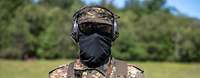
For Ukrainian soldier Andriy P., the designated marksman training is training for survival in war.




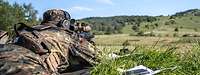
Observe, approach, fire – Ukrainian soldiers undergo effective high-intensity marksman training in Germany.
Time is of the essence. WO I Roger J.* knows this, and so does WO II Franc W. The two instructors, one from Germany and one from Slovenia, have just a few weeks of training in Germany to turn Ukrainian soldiers into designated marksmen. “This training saves lives. It helps us retake occupied cities”, one of the Ukrainian soldiers explains.
The sun is making the air shimmer. Dry leaves are rustling in the wind. But other than that, there is silence. WO II Andriy P.* of the Ukrainian army is lying on the ground, arms resting on the grass, a self-loading rifle in front of him. Using the telescopic sight, he is searching for target 8 out of 10 – a steel disc the size of a human head that is swaying slightly in the breeze. It is nigh invisible to the naked eye, as there are 800 metres separating Andriy P. from his target.
With a slight turn of the dial, he adjusts the scope of his weapon, zeroing in on the target. “You can take the shot now”, says Slovenian instructor Franc W. Andriy P. peers through the cross hairs. No false move now. On the front line, even the slightest lapse of concentration can mean the difference between life and death. Exhaling slowly, Andriy P. pulls the trigger. A clanging sound is coming from the steel disc. Bullseye – at a distance of 800 metres.
What other soldiers would learn over the course of several months during peacetime is now being taught at a German training area within just a few weeks. The location of the site is secret. As for the weapon the marksmen use, it is a semi-automatic rifle with a high-magnification scope, known throughout NATO as the Designated Marksman Rifle – DMR for short. The eponymous marksmen significantly increase the combat power of their country’s armed forces. “Designated marksmen close the gap between infantry, who have an effective firing range of up to 400 metres, and snipers, who can also hit targets at more than 800 metres”, explains the German instructor, WO I Roger J. What this means is that the Ukrainian soldiers will be able to eliminate certain “high-value targets”, as they are called in military jargon, with great precision. “This could be radio operators, officers or machine gunners”, Roger J. elaborates. In short, designated marksmen take aim at the targets that can do the most harm to friendly forces or are essential to the enemy’s combat operations.

Assume firing position, aim, shoot: the soldiers are pushed to the limit. To be successful, they have to maintain maximum concentration even under physical and mental strain.
Bundeswehr/Niclas Baronsky
We, too, do our best: some instructors are from Slovenia, some from Lithuania and some from Germany, but they are all highly committed to their task and share their wealth of experience and knowledge with the Ukrainian soldiers of the mission.
Bundeswehr/Niclas Baronsky
The stakes could not be higher: the Ukrainian soldiers know exactly what they are fighting for. Seven days a week, they train with utmost focus, endurance and discipline. The knowledge they acquire is practical, complex and concise.
Bundeswehr/Niclas Baronsky
I spy with my little eye ... a Russian grenade. Accepting unpredictability as normality – in line with this motto, the soldiers learn to notice irregularities as part of their training.
Bundeswehr/Niclas Baronsky
Nature as an ally: the concept of camouflage is derived directly from the natural world. Here, it is used to great effect against the enemy during the observation and approach phases.
Bundeswehr/Niclas Baronsky
“There is a lot of mental work involved if you want to be a good designated marksman, for example mathematical calculations”, says Roger J. But designated marksmen also have to pay close attention to their surroundings and take lots of factors into consideration when adjusting their sights. One such factor is the wind direction, for headwind will slow down the projectile, and crosswind will change its trajectory. Even the sunlight shining into your eyes can become a problem because after a while, it takes a toll on the pupils, making it seem as though the air were flickering.
“Following a short theoretical introduction, the training quickly becomes about taking the actual shot”, explains the German instructor. The level of difficulty is constantly adjusted: first, the trainees shoot lying on the ground, then standing up or in a kneeling position. Moreover, they are quickly moving further away from the target. “On the first day, the soldiers fire from 500 metres away, and on the next day, it is 700 to 800 metres”, says Roger J. The circumstances under which the soldiers take their shots also become more challenging by the day. In order to simulate the multitude of scenarios awaiting designated marksmen in the real world, it is particularly important to constantly move to new positions in the forest or in open terrain. Before the training is over, the soldiers will have to be able to shoot and hit their target under stress or physical strain. And at the very end, the most demanding task awaits them: shooting at night.
“The goal is for them to accept unpredictability as normality”, says Slovenian instructor Franc W. “The greatest challenge for the soldiers is to estimate the various distances and the associated level of quickness and responsiveness that is required of them.” If the enemy is nearby, you have to act swiftly. If the enemy is further away, designated marksmen and women can act more deliberately without running the risk of being detected. “In both cases, they must hit their target on the first shot”, Franc W. emphasises. “I have taught them everything I know, and I hope that this will help them defend their home country”, the Slovenian instructor adds.
WO II Franc W. is part of the European support mission EUMAM Ukraine. Together with his Lithuanian and German comrades, he trains Ukrainian servicemen and women. Since the beginning of the Russian invasion of Ukraine in February 2022, the European Union and its international partners have provided support to Ukraine not only in the form of materiel and weapons but also in the form of training. In Germany, this training is organised by the multinational Special Training Command (ST-C) based in Strausberg near Berlin. From the start of the EU mission until early 2026, more than 25,000 Ukrainian military personnel received training in Germany alone. The objective of EUMAM UA is to strengthen the defence capability of the Ukrainian armed forces in their fight against the Russian aggressors.
For Ukrainian soldier Andriy P., the designated marksman training is training for survival in war.
To ensure that, by the end of their training, the Ukrainian designated marksmen hit their targets quickly and without being detected, their training consists of a number of closely linked parts: observing, approaching and shooting. Rapidly switching between different processes also helps trainees to increase their responsiveness. “During the observation exercise, also known as ‘stalking’, the soldiers learn to quickly spot irregularities in their surroundings and to neutralise them”, explains the Slovenian instructor. To give an example: if Russian anti-tank weapons were to go unnoticed, that oversight could cost lives. During both the approach and observation phases, effective camouflage (using leaves and twigs, for example) is indispensable. That part of the training is conducted by Lithuanian instructors.
Once designated marksmen or women have spotted their target, they must estimate the distance with great precision. This is one of the most demanding elements of their training. Among other things, they can use their scope to gauge the distance. In rare cases, designated marksmen and women also use laser range finders. Every time the distance changes, notes are made. Constant repetition breeds routine, and by the end of it, these skills have all become second nature to the soldiers. Looking at his protégés, WO I Roger J. from Germany says: “we are doing everything to give our Ukrainian comrades the best training possible because they are not going on some exercise – they are going to war.”
*All names have been changed for the protection of the soldiers.

