
Strategic Deployment
Initial deployment: from provision to effectiveness
Strategic deployability is essential for national and collective defence. National initial deployment precedes deployment.




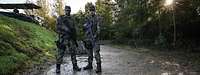
When NATO forces deploy in support of an Ally, Germany acts as a transit country.
It is a hypothetical scenario, yet one we must be prepared for in light of Russia’s attack on Ukraine: The NATO countries are alerted by a large-scale exercise Russia is conducting right at the external borders of Alliance territory. Reconnaissance findings indicate that some 250,000 Russian military personnel are in Russia’s border areas with heavy weapons.
The threat analysis shows that an attack on north-eastern Alliance territory cannot be ruled out. For deterrence purposes, NATO immediately reinforces its forces in Poland and the Baltic. The Allied forces primarily move through Germany to their employment areas.
As a host nation and a hub in the centre of Europe, Germany provides comprehensive support for the Allied troops’ transit as per NATO agreements – with transport escorts, rest areas, fuel, food and more. The challenge is that a large number of German military personnel is already on the way to the area of operations. Their mission is to reinforce the eastern NATO countries and help deter the potential aggressor.
Accordingly, the Bundeswehr on routine duty does not have enough capacity on its own to support friendly countries’ armed forces on their transit through Germany. Additional homeland defence and security reservists are employed for guard and security tasks because of the growing threat of hybrid attacks in Germany.
Civil authorities, including authorities and organisations with security tasks, and commercial contractors are also involved in host nation support. Coordinating these military and civilian support services is one of the Bundeswehr Homeland Defence Command’s main tasks because it exercises command and control over all the Bundeswehr’s operations within Germany, in peacetime, crises and in a state of tension or defence.
Here is how homeland security and defence forces, military police, CBRN defence forces and logistic forces cooperate with state police, the Federal Office of Civil Protection and Disaster Assistance, and civilian contractors.
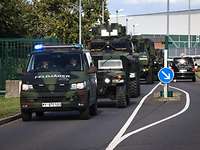
A US military vehicle convoy is about to move from Germany towards the area of operations in north-eastern NATO territory. The simulated route leads from the airport of debarkation in Cologne through Frankfurt and Gera to Görlitz. German and US military police discuss routing, rest points and potentially dangerous locations. Radios are handed out because Bundeswehr military police are escorting the US convoy to the German-Polish border and are in constant communication.
As defence-essential infrastructure, the military part of Cologne/Bonn airport is guarded not only by a civilian security service but also by homeland defence and security reservists protecting the area where US forces are. The reservists have set up an extra checkpoint. Military and civilian police assist them. The military personnel patrol the area inside the facility more, and civilian police reinforce the military police and homeland defence and security forces outside of the restricted military area.
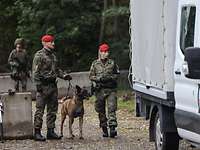
The main entrance to the military section of the airport is blocked by a staged demonstration. For that reason, traffic is rerouted through the side gate, which reservists in homeland defence and security are protecting. The main task at the checkpoint set up is checking vehicles. At the same time, the homeland defence and security forces are continually patrolling the facility and along the outer fence. To this end, they work hand-in-hand with military and civilian police.
When the homeland defence and security patrol encounters an unknown person who is in the restricted military area without authorisation, they want to question this person, who then resists. The military personnel detain the suspect – maybe a saboteur? – and alert the state police so they can hand over the suspect. The military police are also called to check a vehicle. A group of supposed tradespeople in a van have aroused the suspicion of the homeland defence and security forces. One of the men tries to flee but stops when told to. Personnel use mirrors to check the vehicle underbody for explosives but do not see anything. The dog handler from the military police is more successful. His Belgian shepherd sniffs the van and indicates a dangerous substance in the vehicle. Together, the military police and homeland security and defence forces lead the supposed tradespeople away.
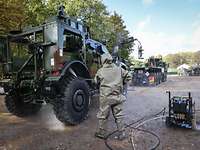
The convoy is on its way through Germany to the theatre of operations. Findings from intelligence sources indicate that acts of sabotage are likely. According to the hypothetical scenario, a hazardous chemical has probably been released in an industrial plant near Erfurt as a result. The police are receiving repeated reports of people inexplicably collapsing in the immediate vicinity of the chemical plant. A situation update from the police, civil disaster control and the Bundeswehr Homeland Defence Command indicates a potential threat to the convoy.
The specialists of the Joint Support and Enabling Service’s CBRN corps are called in. With their specially equipped Mungo protected vehicles and Fuchs armoured CBRN reconnaissance vehicle, the personnel can detect and identify threats caused by warfare agents or comparable hazardous industrial substances – while remaining fully protected and without leaving their vehicle.
The inspection shows that the convoy has been exposed to the chemical. A decontamination station is immediately set up along the route. Multiple vehicles must be treated to restore their combat effectiveness. What looks like an intense carwash is really a precisely defined procedure during which the members of the CBRN corps have to wear full protection and CBRN protective masks for their own safety. After two hours of hard work, the convoy can continue on its way.
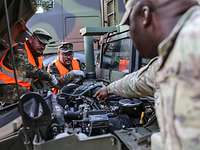
The military transport reaches what is known as a “convoy support centre” (CSC): a military rest area along the designated route through Germany. At the CSC, members of the Allied forces can take a break: eat, shower and rest. All vehicles are routinely checked and refuelled.
Members of many different parts of the Bundeswehr work together at the CSC: logistic forces and technicians from the Joint Support and Enabling Service provide technical support as needed and supply the convoy with fuel. In coordination with military police, homeland defence and security forces patrol the surrounding area and check the entrance to the CSC. If necessary, members of the Medical Service can provide initial medical care. Employees of the Federal Office of Bundeswehr Infrastructure, Environmental Protection and Services provide support with food, accommodations and more. In the future, civilian contractors will increasingly be needed for these rest areas.
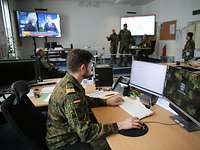
All information on the transport – from the number of vehicles and personnel involved to the current position on the route and any incidents – comes together at the operations centre.
The operations centre prepares and continually updates its situation picture, including not only military transports of the Bundeswehr and Allied forces, but also factors such as weather conditions, road closures, and civilian police and disaster control reports. It also documents reconnaissance findings on hybrid threats, for example to critical infrastructure, as well as sabotage or espionage attempts. The operations centre compiles all this information in a national civil-military situation picture. It operates 24 hours a day, 365 days a year.
The specialists of the Cyber and Information Domain Service major organisational element are also involved in host nation support. These military personnel provide precise data on the weather and usability of the roads. They support the marching troops by providing them with up-to-date digital and analogue maps and charts as well as situational information. In addition, the experts ensure that sensitive information can be transmitted securely between all the relevant parties digitally or by radio. At the same time, they observe cyber and information space, and counter attacks on the Bundeswehr and Allied forces in Germany.
During registration of the convoy at the convoy support centre, the serial commander of the US forces reports that a Humvee broke down several kilometres away. The damage cannot be repaired on the country road, so it was impossible for it to drive any further. The head of the CSC informs the military police and the recovery team. While these personnel prepare to recover the vehicle from the side of the road, the CSC’s maintenance point repairs minor damage to the vehicles that have already arrived and refills their fuels and lubricants.
An injured US servicewoman receives initial medical care. The Medical Service personnel ascertain that the injury needs further treatment. The servicewoman is transported to a nearby civilian hospital.
After stopping at the CSC, the US convoy continues on its way to the theatre of operations. The military personnel will stay overnight at their next stop. Host nation support also includes provision of accommodations.
