Quadriga 2025
More
Airlift in multinational teams
Military personnel trained in aircraft during the air-ground integration training at Southern Griffin – for greater interoperability in emergencies.




What are the tasks of special operations forces in national and collective defence?
From 25 August to 12 September 2025, special operations forces from nine NATO nations conducted the largest special operations forces exercise on Finnish soil to date: Southern Griffin 25. Approximately 1,600 military personnel trained special forces operations on land, in the air and on water in a national and collective defence scenario. The German contribution to the exercise, Silver Dagger, was also part of the Bundeswehr-wide large-scale exercise Quadriga.
The Southern Griffin exercise was organised at the national level and was under the command of the Finnish Utti Jaeger Regiment, the special operations forces of the Finnish armed forces. From NATO’s side, Denmark, Germany, Estonia, France, the United Kingdom, Norway, Sweden, and the United States contributed operational forces, weapon systems, aircraft, boats and other means of transport to Southern Griffin 25.
Participants included military personnel from the Special Operations Forces Command of the Bundeswehr, the 64 Helicopter Wing and the Bundeswehr Joint Force Command. “Finland is a NATO frontline state and with a border of more than 1,300 kilometres, it is one of the potential axes of advance against the Alliance in Europe. Southern Griffin allows us to train special operations under near operational conditions, incorporating all domains and with a multinational approach from the tactical level to the command and control structures, in order to achieve a stronger, more powerful Alliance,” said an exercise participant of the Bundeswehr Special Operations Forces Command.
The fictitious exercise scenario features intelligence indicating an imminent attack by enemy forces in the Baltic region. The Allies immediately deploy special operations forces to the northern flank because there is a threat of invasion in this zone as well. As soon as the North Atlantic Council invokes Article 5 of the North Atlantic Treaty for an attack on a NATO country in violation of international law, the multinational special operations forces stand ready to take action alongside the Finns. Reinforcement forces begin the deployment of personnel and materiel, as Article 5 obliges the NATO nations to render mutual assistance.
The special operations forces are to open up options for action for the follow-on land, air and maritime forces of the NATO states. This means that they gather information about potential targets, position drones, sabotage enemy infrastructure such as airports or train stations, and eliminate air defence systems, weakening the combat power of the enemy’s forces before they continue their attack on the Alliance.

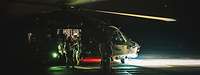
Procedures for airborne operations were practised in air-ground integration training with special operations forces and aircraft from nine NATO nations
PUOLUSTUSVOIMAT/Finnish Defence Forces
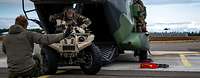
The rapid loading and airlift of small vehicles was also part of the exercise
Bundeswehr/Mario BährIt is of particular importance to quickly deploy forces by aircraft, if the enemy situation permits, to an area of operations where you do not have air sovereignty, for example when enemy air defence or enemy drone swarms are in operation. Lieutenant Colonel Alexander T., pilot and project officer in the 64 Helicopter Wing, is responsible for air support operations planning for Southern Griffin. He explains: “Air forces usually follow decentralised command. Special operations with air support require different command and control processes because everything is faster, with a direct connection to operators on the ground.”
Southern Griffin focuses on the tactical level. All procedures can be trained under conditions that are as realistic as possible, from air-ground integration training (AGIT), where special operations forces teams on the ground and in the air work together multinationally after only a very short preparation period, to low-level flights at night in order to conduct covert deployments, to landing in unknown terrain and without an airfield. “Our pilots don’t know what to expect. The terrain is unknown, the airfield cannot be reconnoitred beforehand and each landing must only take a few minutes. In addition, GPS will fail due to jamming. This is what we call ‘train as you fight’,” says Lieutenant Colonel T.
The challenges for the tactical level are great. “The Arctic is still the Arctic in the summer,” said an exercise participant from the Finnish special operations forces. The rain, mud and difficult terrain from the forests and lakes in the south to the Arctic regions in the north make Finland a unique and complex area of operations. The multinational participation in Southern Griffin is therefore also a signal of Finland’s strategic importance to NATO, said the Finnish officer: “Only in Finland is it possible to train for the defence of NATO’s north-eastern flank.”
According to him, joint training enables us to take rapid and effective action in the event of an Article 5 contingency. Multinational deterrence works best from a position of strength. He explains: “There was no peace dividend in Finland. We are and have been ready for defence thanks to conscription for all young men and a strong reserve. The number of well-trained forces is important. This ensures our sustainability as armed forces and as a nation.” What is particular important: The reserve of the Finnish armed forces also comprises special operations units. Around two thirds of the operational forces in the exercise are reservists.
This is not only true for Southern Griffin. At the same time, approximately 6,000 homeland defence and security forces trained in four regional exercises throughout Finland. The majority are free-play exercises, taking place outside of training areas. The regional reserve is also well trained for their task: to find and engage enemy special operations forces and specialised forces: “No one knows the local terrain as well as our homeland defence and security forces.”
Military personnel trained in aircraft during the air-ground integration training at Southern Griffin – for greater interoperability in emergencies.