




The interviewees:
-
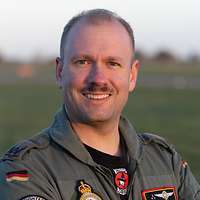
Ewin Major
© Bundeswehr/Tom Twardy -
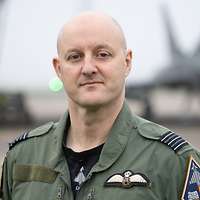
Ian Hart Commander
© Bundeswehr/Tom Twardy


The United Kingdom and Germany share a long-established tradition in training Eurofighter fighter pilots. Commander Hart, Major Ewin, why do Britons and Germans need each other now more than ever?

“Indeed we are currently living in a very particular security situation. Our cooperation is extremely important for NATO. It’s about our people understanding each other and knowing what to do in an emergency. We therefore have to answer the following questions: What do we expect from each other? What do we need to provide?”

“Bilateral cooperation is more decisive than ever. Today, we can no longer be sure whether U.S. support will remain reliable. That’s why the focus is on European cooperation—and the willingness is there. Germany and the United Kingdom work particularly well together; we can fully rely on each other.”
“The key point is this: if we understand each other, we work better together. Our goal is to combine different systems. Naturally, there are systems that are not absolutely identical. This is precisely where interoperability must be established—that is the central issue.”
Who is being trained here?
“I teach pilots of the British No. 29 Squadron at RAF Coningsby how to fly and operate British Eurofighters, including the efficient use of technical equipment as well as weapons employment. I mainly train British Eurofighter pilots, but also pilots from Qatar, France, Canada, and the United States—countries that also have exchange programmes with the UK.”
“It is now up to us to shape the future. Alongside British personnel, we train a wide range of international exchange officers. They don’t just receive flight lessons, but are also trained in weapons handling. And our training doesn’t only focus on pilots, but also on technicians. For both groups, we must ensure they are ready to be deployed to the front line as quickly as possible. To do that, they first need to be taught the fundamentals. Only those who are properly prepared are sent on operations.”
What is the greatest challenge in this training?
“Everyone comes from a different training background. Fortunately, all students arrive with a solid foundation. I always want to get the very best out of my students. The weather can also be challenging, and the airspace is always crowded with aircraft—something pilots must constantly consider while navigating.”
Is that therefore the main focus of the training?
“At the moment we have two priorities: First of all, there is the basic flight training for which pilots are sent to the United States or to Yorkshire. This is followed by advanced tactical training in Coningsby and conversion to specific fighter aircraft such as the Eurofighter Typhoon in order to increase operational readiness. Our goal is for them to complete both phases as quickly as possible—the sooner, the better. The earlier they finish, the earlier they can be deployed.”
Major Ewin, you know both systems: the German Air Force at home and, for over a year now, the British one. What differences are there in the training in Germany and the UK?
“In the UK—unlike in Germany—a larger part of the training takes place in flight simulators. Even ground attacks can be practised in the simulator. From there, pilots move directly into the single-seat Eurofighter. Training then begins in formation flying, low-level flying, one-on-one combat, two-on-one combat, and finally beyond-visual-range engagements. This is followed by QRA training. In Germany, by contrast, flight training is conducted partly in two-seat aircraft and includes fewer simulator components.”
What does it take to be a fighter pilot instructor at RAF Coningsby?
“Experience is the most important thing to me. You need several hundred flight hours—the more knowledge you have, the further you can take your students. Passion is also essential, as is the full support of your family. I completed initial flying training in Arizona, followed by the Euro Nato Joint Jet Pilot Taining in Texas, where I stayed to become an instructor. After that, I did my Eurofighter training to become a regular pilot in an operational squadron. Training pilots for the Royal Air Force is a great honour.”
How do British students feel about being trained by a German?
“My students say my standards are quite high. Training is always a balancing act for me: how strict should I be, how approachable? How high should my expectations be, and how much of a buddy can I still be? Yes, I expect a lot from my students. I simply want them to be the best. I always explain everything in detail—what they can still improve. Earning their trust is a tremendous honour.”
Let’s talk about the “hardware.” Even more than 20 years ago, Britons and Germans jointly procured the Eurofighter. Nevertheless, there are national particularities. What technical differences are there between the British and German Eurofighter?
“The British Eurofighter is considered a highly multi-role combat aircraft because it possesses a particularly wide range of capabilities—first and foremost its powerful engines. Its air-to-air and air-to-ground weapons are also very versatile, allowing it to be used extremely effectively in both aerial and ground combat. British software also differs from the German version, although mechanically the aircraft remains the same.”
Commander Hart, Russia provokes with hybrid tactics. How is NATO airspace adequately protected?
“Alongside the British QRA units in Coningsby and Lossiemouth, the German equivalent is based in Laage. Eurofighters are stationed everywhere and would take off together in an emergency. At the same time, the current security situation makes it clear that closer cooperation is absolutely necessary. We definitely have to identify potential weakness – that is how we become strong together. What really matters is that we train faster and more effectively.”
If multinationality and interoperability are practiced anywhere, it’s here in Coningsby. What is your recipe for success?
“Every nation has its own expertise. We trust them as if they were from the UK themselves. Everyone brings different perspectives and solves problems in their own way, while also learning the British approach. The key is that we constantly adapt our cooperation. And we never treat our partners differently. Everyone brings their individual experience—and together we share outstanding systems.”
How do you assess the future of British-German cooperation in your field?
“The cooperation proved itself, but it should be expanded even further—not just between us, but also with other nations. We can all benefit from this. Take different flight systems, for example: when we train other nations, we also get to know and appreciate their systems. Above all, we must be willing to cooperate. We must not wait.”