Double Interview
More
“I want my flight students to be the best.”
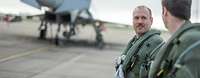
Major Ewin is a German exchange officer serving in the squadron of Wing Commander Ian Hart. How does he train fighter pilots in England?




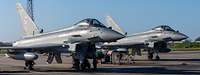
They jointly protect European airspace with their Quick Reaction Alert units. What mindset does a fighter pilot need?
Whoever wants to fight together has to train together: Germany and the United Kingdom are further expanding their long-established cooperation in preparation for emergencies. At the British airbase Coningsby, German fighter pilot instructor Major Ewin trains Eurofighter pilots. What does close combat at 2,000 kilometers per hour in the air feel like? Flight Lieutenant James knows what it’s like.
At the very last second, Flight Lieutenant James pulls his fighter jet sharply upward. Above the British airbase Coningsby, two Eurofighters chase each other, each trying to gain the best possible firing position on the opponent. The RAF officer is practising one-on-one close combat with his German fighter pilot instructor, Major Ewin. After a daring loop, student and instructor thunder side by side over the runway of the RAF base in Coningsby at 280 kilometers per hour. Together, they are training for emergencies.
Allies must be able to work together. A German-British exchange programme demonstrates that this works. We accompany German fighter jet pilot Major Ewin as he trains English flight students at the Royal Air Force base at Coningsby.
In the light of growing tensions on NATO’s eastern flank, the United Kingdom and Germany are strengthening their long-standing defense cooperation. This includes intensified exchanges of German and British Air Force officers. Both nations maintain Quick Reaction Alert units made up of fighter jets. These rise into the air, for example, when aircrafts enter NATO airspace without authorisation and must be able to respond simultaneously. Military personnel refer to this ability to operate together as “interoperability”. Joint fighter pilot training on the Eurofighter – in both the British and the German versions – make a key contribution to this. Therefore, German exchange officers are assigned to one of the Eurofighter Typhoon Squadrons at RAF Coningsby, while their British counterparts serve in Rostock-Laage. Only those who understand how their allies think and work can effectively protect European airspace together.
“Everything went smoothly,” Major Ewin reports as he emerges from the debriefing together with Flight Lieutenant James. His student is still overwhelmed by his experience in the air. “In Eurofighter combat, it really is all or nothing. At first, the opponent is just a tiny dot in the distance that suddenly keeps getting bigger”, James says enthusiastically. “You start radioing like mad, and from one second to the next it’s up and down. Him or you: five seconds decide everything. Your legs and your chest are compressed until there’s no space left and you can’t move anymore.”
Both the southern Quick Reaction Alert unit and the Royal Air Force’s 29 Squadron are stationed at RAF Coningsby. British fighter pilots like Flight Lieutenant James are trained here, as well as pilots and technicians from France and Italy, the United States, Canada and Qatar. As a German officer, Major Ewin is fully integrated into the British unit and independently trains future fighter pilots. After six to nine months of training, they have a realistic chance of serving as pilots in a Quick Reaction Alert unit protecting NATO airspace in Europe. “That’s my biggest wish”, says James who has been with the Royal Airforce in Coningsby since the summer.
British fighter pilot training follows a special concept: immediately after simulator training, things get serious for the students – without a safety net. Unlike in the German Air Force, British trainee pilots fly the Eurofighter entirely on their own. “In Germany it is mostly two-seat that is used for fighter pilot training, with student and instructor together”, Major Ewin explains. “Not so in England. Here, the Eurofighter—even during training—is practically always single-seat.”
Flight Lieutenant Will vividly remembers his first Eurofighter flight: “An incredible noise. And the acceleration! In five seconds, you’re almost vertical.” Trainee pilots are taught not only formation flying but also one-on-one or two-on-one air combat. In addition, combat beyond visual range is practised. In such scenarios, the target can even be up to 200 kilometres away, – depending on the guided missiles that are used. Low-level flight manoeuvres are also part of the curriculum. Will enjoys these the most: “Here we fly extremely low—down to 250 feet.” That’s about 75 metres. “Actually, it’s quite dangerous. Very tough, but really cool.”
Major Ewin is a German exchange officer serving in the squadron of Wing Commander Ian Hart. How does he train fighter pilots in England?
Once, the basics are mastered, training for the QRA unit follows. “Pilots learn the specific skills here in Coningsby. They receive the final polish for deployment at additional training locations,” explains Major Ewin. “For example, we spent a week at RAF Lossiemouth, where we learned additional combat tactics,” James adds. Flexibility is especially important. “That’s why we don’t only train with aircraft we’re already used to but also other fighter aircraft, such as the F-15”, Will explains. “And we definitely have to train in different surroundings.”
Before every flight, a detailed situation and weather briefing takes place in the base’s operations support centre. Major Ewin and the Royal Air Force instructors go through every detail before heading into the air with their students. Before taxiing to the runway, all Eurofighters are thoroughly checked by aircraft mechanics technicians. The pilots inspect their aircraft closely: Is anything leaking? Are all safety pins really removed? After all, in a real operation, the weapons must work.

Faster than sound: Powered by its EJ200 engine, the Eurofighter Typhoon accelerates to over 1,000 kilometres within 30 seconds – without afterburner. This allows it to strike at lightning speed, pursue targets and counter threats.
Bundeswehr/Tom Twardy
A well-rehearsed team: Major Ewin and Flight Lieutenant Nation discuss the training schedule for their student fighter pilots. Today’s lesson for the advanced group is two-on-one air combat. In a real emergency scenario, even with fog included.
Bundeswehr/Tom Twardy
Off we go: A mix of absolute concentration and strong confidence in intensely trained skills give fighter pilots their edge. Each of them mentally runs through the flight route once more – in seconds, everything will be at stake.
Bundeswehr/Tom Twardy
Final check: Before take-off, Flight Lieutenant Nation inspects his Eurofighter down to the smallest detail. All components in order? Weapons systems ready for combat? In a real mission, everything must work flawlessly in a matter of seconds.
Bundeswehr/Tom Twardy
Ready for take-off: In the UK, trainee fighter pilots train from the outset in a single-seat Eurofighter – connected only by radio. A two-seater is used in training only for exceptionally hazardous exercises.
Bundeswehr/Tom Twardy
Catch me if you can: In one-on-one air combat, both Eurofighters try to gain the best position to engage the opponent. Germany and the UK train close-range combat together for real-life scenarios.
Bundeswehr/Tom Twardy
The supreme discipline: Landing side by side in formation at 280 kilometres per hour is an extreme challenge. Those who master it best are allowed, after completing their training, to take part in international air shows with Royal Air Force team.
Bundeswehr/Tom Twardy
On the same wavelength: Germans and Britons are linked by a long-standing Eurofighter partnership. So, they understand each other instinctively, knowing exactly how the other operates. Both aim to intensify this exchange to protect NATO airspace.
Bundeswehr/Tom TwardyAfterwards, a wide range of combat scenarios for beginners and advanced pilots are practised. After two or three hours, instructor and student meet for a debriefing. Successful manoeuvres are praised, mistakes analysed. After all, all students must attain the same operational level—a major challenge. “But even though my students bring different degrees of experience, they already have a remarkably high standard,” explains the German instructor. “And the best thing for me is when they leave the debriefing with a big smile and I know: they’ve made it.”
James and Will enjoy working with their German and British instructors. “Everyone has a good sense of humor,” Will emphasizes. Teaching styles also show no major differences. British flight instructor Tom Nation sees his German colleague the same way: “He’s just like any other pilot. In the end, we all work in similar ways, while also learning from each other.”
The German fighter pilot instructor was also granted a special honour. For the first time, a German Air Force officer was allowed to take part in the 2025 Victory Day celebrations in the United Kingdom with a British Eurofighter. “That flypast was my personal highlight.” A symbolic gesture on the 80th anniversary of the end of World War II in Europe - showing both nations can fully rely on each other.
“If a conflict breaks out, German–British cooperation is especially important. It’s absolutely vital for us to work together”, James stresses “British–German cooperation is our key priority—especially given the many uncertainties and questions currently arising from the situation in the United States,” Will emphasizes. “That’s why the British–German exchange is important for both sides—we both have excellent pilots and technicians.” Above all, both allies share one common goal: “We do everything to be prepared. Even for the worst case.”
* Name changed to protect the soldier.
by Kristina Stache
