





Combining Efforts in Medical Support
The Multinational Medical Coordination Centre – Europe (MMCC-E) is a multinational planning and coordination entity dedicated to enhancing medical support for European armed forces. It was established on 1 April 2018 in Koblenz following close European cooperation within NATO’s Framework Nations Concept. Originating from a joint Declaration of Intent signed by several European military medical services, the MMCC-E combines NATO and EU medical initiatives under one structure.
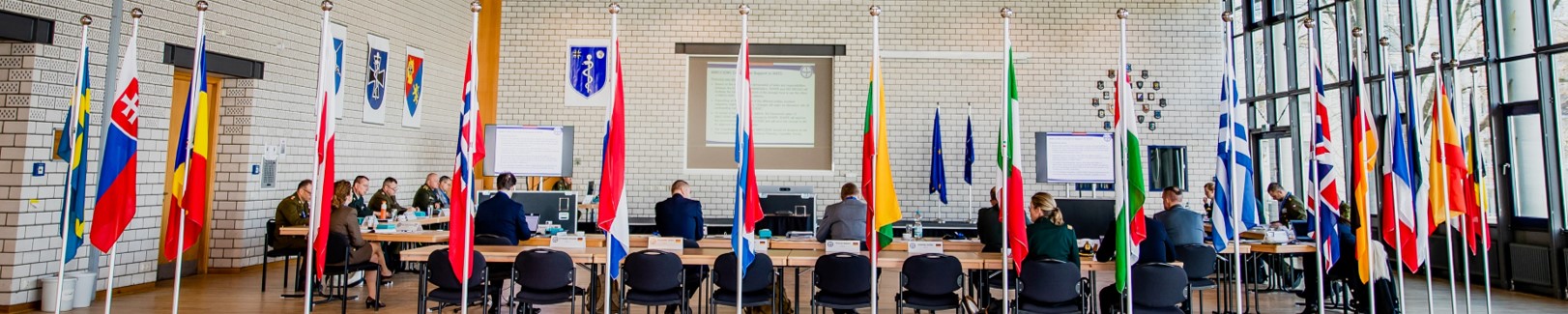
Today, the MMCC-E comprises 19 member nations, including Belgium, France, Hungary, Netherlands, Switzerland and numerous other European NATO and EU partners. With this broad multinational composition, the MMCC-E serves as Europe’s central hub for medical operational planning, coordination, and cooperation.
Its mission is to create the conditions for multinational medical support across the full spectrum of military operations. This includes joint planning efforts, capability coordination, the optimization of multinational processes, and the development of medical concepts—such as strategic patient evacuation and medical crisis management.

Brigadier General (OF-6) (MC) MA Thorsten Schütz

Structure of the Multinational Medical Coordination Centre-Europe
BundeswehrThe Deputy Director for EU Affairs is responsible for coordinating EU-related tasks and work and is filled by the French Armed Forces.
The Deputy Director for NATO Affairs is responsible for coordinating tasks and work related to NATO and is filled by the Dutch Armed Forces.
The task of the Executive Officer as Head of Central Tasks is to coordinate staff work and to allocate resources to accomplish tasks in consultation with the directors.
Operations / Plans – The scope of tasks includes conceptual development of the MMCC-E itself as well as for the needs of participating nations, NATO and EU. The main focus lies on the management of largescale patient transport, named as “Patient Flow Management”. Further tasks are contributions to nations’ and organisations’ medical conceptual documents and capability development. The branch also provides the core team for the staffing of the central coordinating element of the Patient Flow Management, participating in the preparation, execution and reviewing of exercises, especially NATO’s STEADFAST exercise series, closely cooperating with the JMED elements of SHAPE/ACO, JSEC, the three JFC and the participating Component Commands and Corps.
The scope of work for the MedSA/ Civ-Mil Interface structural element focuses on establishing and coordinating a robust network of civilian and military experts. This network includes MMCC-E member nations, NATO entities ( e.g. the Joint Health Group (JHG)), and EU institutions ( e.g. DG ECHO, SANTE, HERA).
Key Responsibilities and Activities:
Our mission encompasses the comprehensive planning, preparation, and execution of the Casualty Move (CAMO) exercise series, which has been established as a recurring cycle of multinational training events. In addition, we carry out a broad range of support tasks, including contributions to multinational patient flow management to ensure smooth processes and effective coordination. Another key focus lies in the design, preparation, and implementation of wargames aimed at reviewing and validating existing Standard Operating Procedures (SOPs). These activities allow us to test and refine procedures in advance through Rehearsal of Concepts (ROC) drills, serving as an essential step in quality assurance and readiness for subsequent major exercises.
The responsibilities within the field of Medical Logistics include providing expertise on medical support rates as well as key aspects of medical supply management, such as storage and transport requirements for medical materials, compliance with the Geneva Conventions, and best practices in medical supply chain management. They also involve aligning logistical processes with the needs of Medical Supply Units and ensuring the interoperability of medical supplies through joint procurement initiatives and the exchange of information on available products.
Another essential task is to create transparency within the complex and often competing regulatory frameworks of NATO, the EU, and national legislation, while simultaneously promoting the harmonization and elevation of shared standards—for example, in the regulation of blood and blood products. Additionally, Medical Logistics supports the coordination and use of multinational training opportunities within NATO and EU logistics, thereby strengthening cooperation, preparedness, and overall effectiveness in multinational medical support.
The mission of the organization focuses on comprehensive monitoring of the CBRN situation through the exclusive use of secure and classified information sources. It supports a wide range of projects and responds to inquiries from the EU, NATO, and the member nations of the MMCC-E in the fields of medical CBRN protection, digital competence, and telemedicine as well as body-sensor technologies.
A key task includes securing funding from the European Defence Fund to strengthen innovative capabilities. In addition, the organization contributes to Federated Mission Networking (FMN), enhancing command-and-control connectivity among currently 35 participating military organizations. Another central responsibility is the development of standardized data protocols that enable seamless, interoperable, and secure cross-border exchange of medical information, ensuring compatibility of future medical software and IT systems across national and institutional boundaries.
Advance through Rehearsal of Concepts (ROC) drills, serving as an essential step in quality assurance and readiness for subsequent major exercises.

Public Affairs Officer

Multinational Medical Coordination Centre-Europe
Andernacher Straße 100
Rheinkaserne
56070 Koblenz
