
National and collective defence
NATO’s Allied Reaction Force
The Alliance’s rapid response force is in constant readiness. On its homepage, NATO explains how the ARF works.




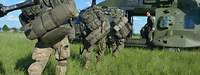
Russia is the biggest threat to peace in Europe. The ARF is in constant readiness to defend NATO.
Robust, multinational and responsive: In July 2024, the Allied Reaction Force (ARF) was established as a high-readiness NATO force for deterrence, crisis management and common security. 40,000 military personnel are ready to go wherever their capabilities are needed.
At this time, the main ARF troop contributors are Italy, Spain, France, the UK and Turkey. The troop contributors rotate with their contributions once a year. Germany’s contributions to the ARF include its ongoing participation in NATO’s Standing Naval Forces. Germany provides frigates, mine countermeasures units and supply ships.
Ultimately, the ARF ensures that highly prepared forces are readily available to SACEUR, providing rapid response options for any situation.
If NATO’s North Atlantic Council decides to deploy the ARF, the force will be under the command and control of NATO’s Supreme Allied Commander Europe (SACEUR). As of July 2025, US General Alexus G. Grynkewich is SACEUR. With the ARF, SACEUR has a rapid response force to counter any threat. The ARF must be mission-ready within ten days of alerting.
This large force replaces the previous NATO Response Force with its Very High Readiness Joint Task Force (VJTF) of around 20,000 military personnel. The ARF can be reinforced with forces from the NATO Force Model (NFM) as needed. This model calls for some 100,000 military personnel to be mobilised within ten days to defend NATO territory. Another 200,000 additional forces are to be mission-ready after a maximum of 30 days, and 500,000 more military personnel after no more than six months. Within the framework of the NFM, Germany has agreed to provide around 35,000 military personnel, as well as 200 ships and aircraft, within the first 30 days to defend the Alliance.

A powerful response: In addition to the Allied Reaction Force, NATO’s member states will mobilise around 800,000 more military personnel within six months to defend NATO territory if the Alliance is challenged.
Bundeswehr/Astrid HöfflingThe Strategic Concept adopted at the 2022 NATO Summit in Madrid calls Russia the biggest threat to peace and stability in the Euro-Atlantic area. In addition, international terrorism in all its forms is a threat to security and peace in the world. In NATO, the ARF plays a key role in countering these threats. ARF forces can handle all types of operations, from humanitarian assistance to disaster control, from noncombatant evacuations to offensive operations within and outside of European NATO territory.
The ARF was established on 1 July 2024. Its staff will initially be based near Milan, Italy for three years. In September 2024, part of the ARF moved out for the first time, to conduct exercises in Kosovo. In early 2025, the ARF trained in Southeast Europe to prepare for mobilisation and deployment in the event of a state of defence. 10,000 military personnel from nine NATO countries participated in the exercise.
In early 2026, ARF units are coming to Germany for NATO’s Steadfast Dart exercise. They are practising deployment from their home countries through Germany as a hub in order to train for the processes necessary in a state of defence. The NATO exercise is linked to the Bundeswehr’s Quadriga exercise series, held just afterwards. The main focus there will be on transport and medical care for injured military personnel.

