German-British Exchange Programme
More
“This is where contacts are made for times of crisis”
Jack E. is a Royal Navy Lieutenant serving under Commander Christoph S. aboard a German warship. How does that work in practice?




The German and the Royal Navy are expanding their joint maritime surveillance. What role does navigation officer Lieutenant Jack E. * play?
It is three o’clock in the morning. Lieutenant Jack E. stands on the bridge of the German frigate “Baden-Württemberg“, carefully watching the dark waves of the North Atlantic. Beside the British navigation officer are several comrades in Bundeswehr uniform, whom he is introducing to bridge watchkeeping duties aboard the warship. “Can you see those two navigation lights?” the Briton asks a German officer cadet. “That’s a container ship, about 300 metres long and almost fifty metres wide.”
The warship and the merchant vessel must not come too close. Jack E. turns to the helmsman. “Port ten degrees,” he orders. The helmsman brings the frigate onto her new course while the navigation officer carefully monitors the manoeuvre. The experienced British officer takes a brief sip of tea. Another challenge successfully navigated.
Lieutenant Jack E. has been a member of the crew of the German frigate “Baden-Württemberg“ since May 2024. Raised in a village near Leicester — “actually quite a long way from the sea,” as he puts it — he had always been fascinated by naval service. He joined the Royal Navy in 2019 and later served aboard the aircraft carrier HMS “Prince of Wales“. Wanting a new challenge, he applied for the German-British naval exchange programme and was selected. Today, the Lieutenant trains young officers on the bridge of the “Baden-Württemberg“ and works alongside other watchkeeping officers, such as Lieutenant Malte T.

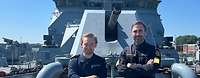
Meet Lieutenant Jack E.: Since May 2024, the Royal Navy officer has strengthened the “Baden-Württemberg“ crew. When training German naval officers, he relies on an effective combination of advanced technology and traditional navigation techniques.
Bundeswehr/Christoph Kassette
Learning to make quick decisions: The interpretation of electronic charts is essential for informed and networked decision-making. The British navigation officer ensures that his trainees take responsibility at an early stage.
Bundeswehr/Christoph Kassette
Staying alert to danger: To react instantly in any situation, Lieutenant Jack E. combines information from radar, radio communications and GPS. On top, he maintains visual awareness of his surroundings — with binoculars remaining indispensable.
Bundeswehr/Christoph Kassette
Independent even without GPS or radar: Traditional navigational skills are regularly practised in case modern systems fail. Using compass and parallel rulers, Lieutenant Jack E. demonstrates position fixing and route planning to his German colleague.
Bundeswehr/Christoph Kassette
11,000 Nautical Miles East of Wilhelmshaven: During the Indo-Pacific Deployment in September 2024, Lieutenant Jack E. was already instructing his German shipmates in navigation procedures – here in an exercise with New Zealand’s Navy.
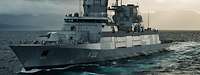
Bundeswehr/Leon RodewaldIf the bridge is the frigate’s eye, then the operations room is its brain and the control room its heart. Only when all parts work together perfectly can the warship unleash its full capability. And that capability is impressive. The “Baden-Württemberg“ is one of the largest warships in the German Navy. At around 150 metres in length and with a range of 4,000 nautical miles — more than 7,400 kilometres — she can operate around the globe. A crew of approximately 150 sailors is required to run the frigate.
Following the end of the Cold War in the 1990s, the F125-class frigates were designed primarily to combat asymmetric threats such as piracy and smuggling. However, since Russia’s invasion of Ukraine in 2022, collective defence and national security have once again become the primary focus. As a result, cooperation between Germany and the United Kingdom has gained even greater importance. “The number of joint exercises involving the German Navy and the Royal Navy has increased significantly in recent years,” says Commander Christoph S., Executive Officer of the “Baden-Württemberg“.
The two navies also cooperate closely in operational preparation and training. German frigates participate in the German Operational Sea Training (GOST) programme off the south coast of England, where crews practise mission-relevant skills using training procedures coordinated with the Royal Navy. “Thanks to this common and standardised training, we are always able to operate together as a task group at short notice,” explains Commander Christoph S. One major area of cooperation is the protection of the North Atlantic, particularly against Russian submarine activity and the so-called Russian shadow fleet.
Exchange officers such as Lieutenant Jack E. play an important role in this process because they gain first-hand knowledge of how their allies work. “When Jack returns to the Royal Navy after two years, he will immediately understand how things are done aboard a German frigate and will be able to pass that knowledge on to his own sailors during joint operations,” says Commander Christoph S. According to his German superior, the British navigation officer serves as an important multiplier of expertise. At the same time, German sailors gain valuable insight into the perspective and professional culture of British naval officers.
Jack E. is a Royal Navy Lieutenant serving under Commander Christoph S. aboard a German warship. How does that work in practice?
Like his German shipmates, Jack E. first had to complete a specialised qualification, essentially a “frigate driving licence” for bridge watchkeeping officers aboard an F125-class frigate. “That means I am now qualified to navigate both German and British warships,” explains the British officer.
“His calm manner is particularly valuable in difficult situations,” says Lieutenant Malte T. about his British colleague. The Lieutenant enjoys not only the trust of the commanding officer but of the entire crew. “He’s one of us,” says Malte T. For him, Jack E. is both a role model and a fellow sailor from whom he has learned a great deal. Malte T. himself is highly interested in participating in an exchange programme with a NATO partner and can easily imagine serving under the British flag for a period of time. “Only by intensifying our international relationships can we combine our strengths,” he says regarding German-British cooperation. “We know each other, and we trust each other. That is the foundation for carrying out our mission within NATO.”
*All names have been abbreviated to protect the individuals concerned.

