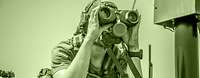
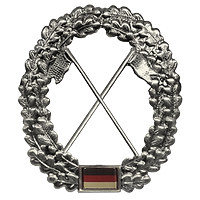
The Intelligence, Surveillance and Reconnaissance, or ISR, Corps is a branch of the Army. It is part of the combat service and command support forces and was activated on 6 March 2008 by the Chief of the Army. Its soldiers are referred to as reconnaissance troops or, colloquially, as scouts. They wear black berets and, in the tradition of the cavalry, golden-yellow braids and collar patches. Personnel assigned to the Division Schnelle Kräfte (DSK), or Rapid Response Forces Division, wear a maroon beret. The cap badge shows two crossed lances. They are reminiscent of the branch’s cavalry origin.
The primary task of the branch is to conduct reconnaissance – in other words, to gather information about opposing forces (such as enemy soldiers) and the terrain. The ISR Corps is the mainstay of Army reconnaissance and intelligence collection activities. It is part of the integrated intelligence collection and reconnaissance system of the armed forces.
Collecting information on crisis areas
Intelligence collection and reconnaissance is a joint task throughout the Bundeswehr. It is not limited to the Army and is fully effective only when different systems interact with one another in a system of systems. The result is a comprehensive, up-to-date situation picture. All forces engaged in intelligence collection and reconnaissance collect and capture situationally relevant information and intelligence around the world on areas of interest, crisis areas and areas of operation, and evaluate and disseminate the data to the user.
The ISR Corps is the mainstay of Army reconnaissance. Its structure and procedures are designed to meet the commander’s information requirements in the field and to provide a comprehensive situation picture with as few gaps as possible. The ISR Corps can also complement, consolidate, and verify reconnaissance results provided by other reconnaissance assets. In so doing, it also makes an important contribution to in-theatre force protection.
The branch is headed by the Director, ISR Corps, who is also the Commandant of the Army ISR Training Division at Munster. This is the central training facility of the ISR Corps.
The ISR Corps is equipped with a variety of different technologies and equipment. For instance, its soldiers use various types of vehicle, such as the Dingo all-protected carrier vehicle, the Fennek reconnaissance vehicle and the Fuchs armoured transport vehicle.
Unmanned aerial vehicles such as the ALADIN, KZO and LUNA reconnaissance systems are also available to ISR Corps personnel.
The Fennek reconnaissance vehicle is the main weapon system of the ISR Corps.
Due to its low profile, it is already difficult to observe from afar. Flattened vehicle contours reduce surface reflection, protecting the vehicle from an adversary’s radar. The Fennek is very quiet. It has a powerpack with a reduced acoustic signature so that it can stay undetected for as long as possible. It is also equipped with a wide array of sensors. The interaction of the various sensors enables ground-based, long-range scout reconnaissance.
A core component of the Fennek is its BAA on-board observation and reconnaissance equipment. It includes a daylight camera, a laser range finder and a cooled thermal imager. The cooling reduces the temperature of the imager itself, thus improving its reconnaissance capability. This high-tech triad detects targets at a distance of up to 10 kilometres. The identified coordinates are fed directly into the Army’s command and control and information system.
The observation and reconnaissance equipment is mounted on a telescopic mast that can be extended up to one metre and rotated 360 degrees. The crew can also use the observation and reconnaissance equipment without the mast for dismounted observation. A few steps are enough to remove the equipment from the vehicle and to place it on a tripod in another location. A cable ensures a steady connection to the vehicle. The crew uses the control panel inside the vehicle to operate the observation and reconnaissance equipment. Remotely operating the equipment is particularly suited for observation missions from concealed or hidden positions when mounted observation is impossible.