
Defence and the Bundeswehr
Defence is one of the Bundeswehr’s most important tasks. However, it performs this task within NATO rather than on its own.




Germany is already a target of Russian hybrid attacks. General Alexander Sollfrank made this clear at the Bundeswehr conference in Berlin on 7 November 2025. The Bundeswehr is not idle in the face of this threat. However, the protection of Germany and its citizens requires not only operational armed forces, but the whole of society.

The implementation of the OPLAN for the defence of Germany can only succeed if the entire society is involved, Lieutenant General Alexander Sollfrank stated
Bundeswehr/Christian Vierfuß“We are committed to ensuring Germany’s security every single day – not merely in theory, but in practice.” With these words, Lieutenant General Sollfrank, Commander of the Bundeswehr Joint Force Command, made it unequivocally clear how serious the security situation is. As the person responsible for operational planning and command and control in the entire range of tasks of the Bundeswehr, a comprehensive and up-to-date situation picture is essential for him. He is also in charge of planning the reception, staging, onward movement and integration (RSOI) of allied forces in and via Germany for national and collective defence. All of this has already been laid out in the Operation Plan (OPLAN) Germany, a classified document that is continuously adapted to the current situation by the service personnel of the Joint Force Command.
However, Lieutenant General Sollfrank stressed that a seamless implementation of the OPLAN Germany in case of an emergency requires not only well-equipped and operational forces but also the support of civilian companies and all citizens of the Federal Republic. A resilient society is, after all, essential to defending against hybrid threats or military attacks, according to him.
Georgia in 2008, the annexation of Crimea in 2014, the war in eastern Ukraine, and, since February 2022, the all-out war of aggression against Ukraine, which has already led to about 14,000 dead and about 35,000 injured civilians on the Ukrainian side and probably to about 900,000 wounded and fallen Russian soldiers. With this list, General Sollfrank illustrated that Russia does not shy away from the use of military force. “We are, of course, observing very closely how Russia is fighting, what strengths and weaknesses of the Russian armed forces we can identify and what lessons we can learn”, the Commander of the Joint Force Command emphasised.
This monitoring also shed light on how Russia is able to drive a massive buildup while continuously developing its military capabilities despite the war. For example, Russian stockpiles of artillery ammunition and missiles will almost double between 2022 and 2030. In addition, the manpower of the Russian armed forces is currently growing to 1.5 million soldiers, according to the General. “Despite the war in Ukraine, Russia clearly has a very large military potential. This means that it is already capable of conducting a regionally limited attack on NATO territory”, General Sollfrank concluded. Nonetheless, he added that the Bundeswehr and NATO do not presently assume that such an attack is currently likely.
General Sollfrank explained that, in addition to the all-out war in Ukraine, Russian cyber attacks are already targeting other European states, including Germany – and thus also the Bundeswehr. “Both the war in Ukraine and these attacks against us are elements of Russia's overall strategic approach aimed at changing the entire security architecture in Europe”, the commander said, stressing that Germany is a particularly important target for Russia in view of its geographic location at the heart of Europe and on account of its economic and political importance.
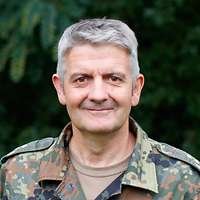
“Being able to fight so we won’t have to fight. This is what the OPLAN Germany stands for and why we serve: to ensure peace through credible deterrence.”
The Bundeswehr not only analyses Russian aggression, it actively protects Germany and its population. The protection of military infrastructure, but also the protection of civilian underwater infrastructure in the Baltic Sea, for example, has been reinforced, according to General Sollfrank, who also stated that the Russian shadow fleet and the Russian warships operating in the Baltic Sea are under increased observation, while protection of Alliance airspace is being tightened. Above all, however, stands the refinement and further development of the OPLAN Germany, which seamlessly fits into NATO's collective defence, the General said. The plan has three objectives:
to protect Germany and its citizens from military attacks,
to protect Germany from hybrid attacks,
to ensure deployment of allied NATO forces to the eastern flank of Alliance territory via Germany and to ensure their protection and supply.
The OPLAN Germany and the military capabilities derived from it serve one major purpose, as General Sollfrank stressed, namely to “maintain peace through credible deterrence”.
Should a situation arise in which an attack is imminent, RSOI of NATO forces should ideally be completed before the first shot is fired. This would show the potential aggressor that an attack would not succeed, the General continued, stating that to ensure this, the Bundeswehr relies on civilian companies and the performance of the German economy. “Without civilian public and civilian commercial support, the OPLAN Germany cannot be implemented”, said the General in charge.
Civil-military cooperation and individual responsibility
Ports, airports, road and rail networks – all of this is needed to bring the troops from Germany to the eastern flank in the event of an emergency and to supply them there, General Sollfrank said. This is just one example of where the Bundeswehr relies on civilian infrastructure and its operators. Therefore, contracts have already been concluded, for example with Deutsche Bahn, the Autobahn GmbH or with companies responsible for resting and assembly areas, General Sollfrank explained.
The Commander of the Joint Force Command also pointed out that, within the legal framework in peacetime, the Bundeswehr can only support the fight against hybrid attacks through administrative assistance and that civilian authorities are needed in this regard just as much as each citizen. In case of an emergency, a resilient population is indispensable in resisting hybrid measures as well as in the context of overall defence, according to General Sollfrank, who concluded that “the example of Ukraine shows that successful defence is a task for society as a whole”.
by Ole Henckel