Unified command and control
More
Bundeswehr Joint Force Command
In future, the Bundeswehr will plan and conduct its operations at home and abroad from a single command in Berlin and Schwielowsee.





A core military element of overall defence
The security situation in Europe has changed fundamentally. Russia’s full-scale attack on Ukraine in violation of international law on 24 February 2022 has brought war to Europe once again. Today’s Russia is considered the greatest threat to peace and security in Europe. In response to this profound change in the security environment, the German government’s 2023 National Security Strategy defined the objective of a policy of Integrated Security as a whole-of-society task: “the collaborative interaction of all relevant actors, resources and instruments that, in combination, can comprehensively guarantee the security of our country and strengthen it against external threats”.
The Operational Plan for Germany is an essential military component of Germany’s overall defence. It combines key military elements of national and collective defence with the necessary civilian support services. Lead responsibility for the Operational Plan for Germany lies with the Bundeswehr Joint Force Command.
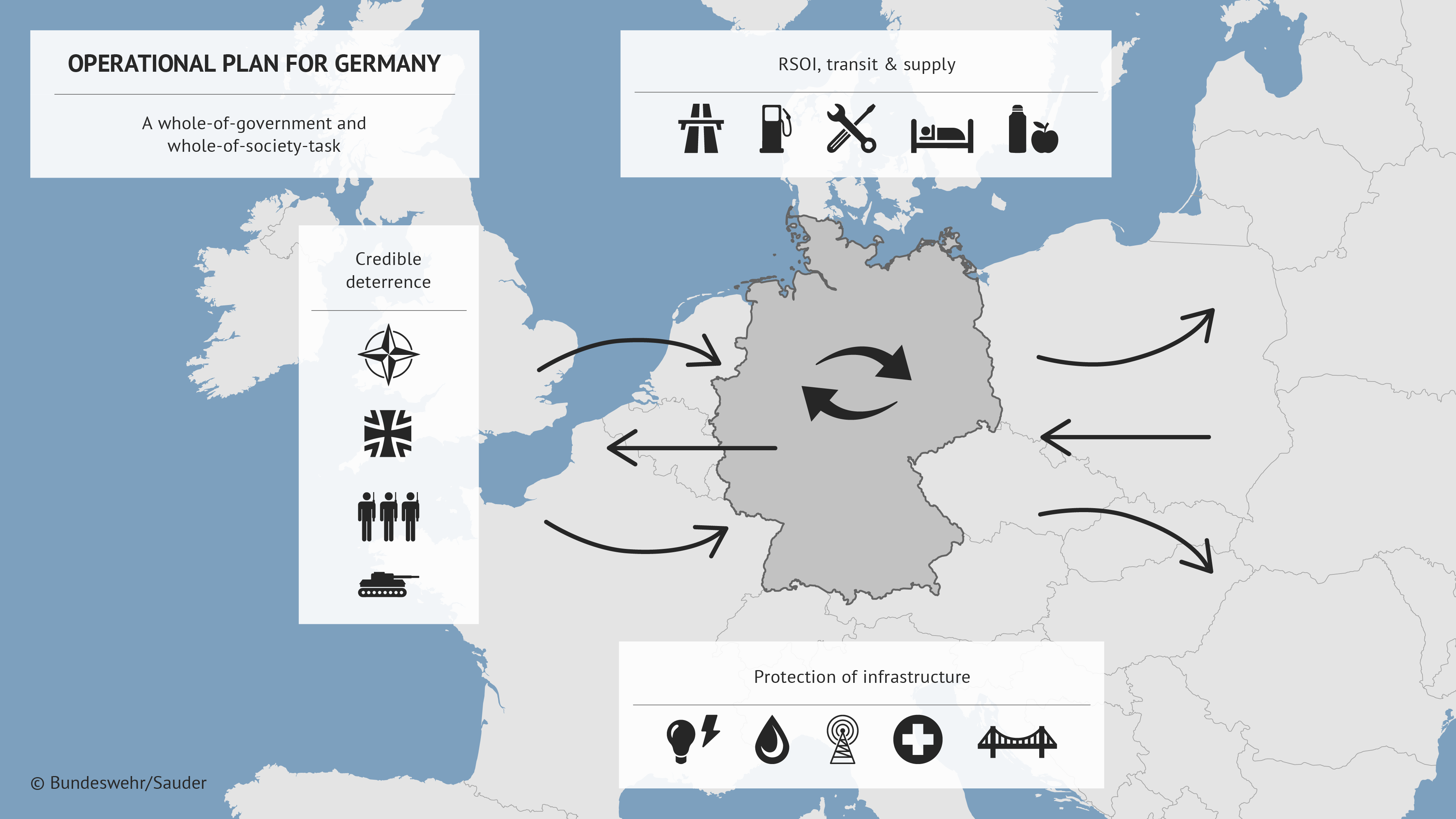
Credible deterrence and effective defence require that operational armed forces quickly be ready and combat capable at NATO’s external borders in an emergency. The Operational Plan for Germany makes an important contribution to this.
Bundeswehr/Carolin SauderThe document comprises over 1,000 pages, and the details are classified. Multiple ministries were involved in preparing it, and it is updated regularly. The first version was issued in early 2024, and the second is expected to be ready by mid-2026. Lead responsibility in the Bundeswehr lies with the Bundeswehr Joint Force Command in Berlin and Schwielowsee, in close cooperation with the Federal Ministry of the Interior and the federal states.
A core element of the Operational Plan for Germany is bringing together the key military elements of national and collective defence with the necessary civilian support services for mutual whole-of-government support at various levels of escalation – in peacetime, hybrid threat situations, crisis and war. This involves military support for civilian preparedness for war on the one hand and, on the other hand, civilian contributions to military defence planning. The plan includes processes and responsibilities, e.g. for the Bundeswehr’s cooperation with civilian or government entities in an emergency. The Operational Plan for Germany does not cover other aspects of civilian preparedness that are outside the Bundeswehr’s area of responsibility, such as providing basic services to the population.
Germany’s commitment to the Alliance, arising from its geostrategic location as a hub for NATO in the middle of Europe, plays a key role in the OPLAN DEU. In an emergency, up to 800,000 allied troops and 200,000 vehicles must be able to pass through Germany within six months and receive host nation support. This support ranges from protection and security, traffic management, transport and transloading by road, rail, seaport and airport, accommodation and messing, refuelling and maintenance, to medical care and legal advice. This support can only be ensured – at short notice and for a long period of time – using services from civilian commercial partners.
Germany’s role as a hub is therefore a whole-of-society task that will also entail inconveniences for the population but is essential to the security of Germany and its partners. After all, RSOI and supply of allied and German forces lay the foundation for having the right forces in the right place at the right time with full operational capability – for credible deterrence and effective defence within the Alliance.

Supporting the armed forces of friendly nations in host nation support is an important obligation that NATO partners have to each other. It includes traffic planning and movement control for troops in transit, for example.
Bundeswehr/Sven Riedel
Support services range from maintenance and refuelling to providing food and accommodation or legal advice; here, we see a maintenance halt for US armed forces.
Bundeswehr/Anne WeinrichThe Operational Plan for Germany (OPLAN DEU) is a core element of the military component of Germany’s overall defence. It is a viable plan that brings together the key military elements of national and collective defence in Germany with the necessary civilian support services. It provides the planning to ensure that purposeful and constitutionally sound action can be taken following a political decision in the event of a crisis or conflict. The aim of the Operational Plan for Germany is to enhance cold-start capability, warfighting capability and sustainability, and adapt them to security challenges.
Since Russia’s attack on Ukraine in violation of international law in February 2022, NATO has been strengthening its defensive measures in Central, Eastern and Southern Europe. Today’s Russia is for now the most significant threat to peace and security in the Euro-Atlantic area. Even now, Germany mainly faces threats from the hybrid spectrum of hostile actors – disinformation campaigns, cyber attacks, espionage and sabotage – where the perpetrators usually cannot be clearly identified.
It has become almost impossible to separate internal security from external security as they are highly interdependent. Germany’s ability to act externally also increasingly depends on its internal robustness and resilience. These challenges cannot be met purely at the military level. They need to be dealt with as a whole-of-government and whole-of-society task. Effective deterrence requires a credible defence capability.
This includes Germany’s prominent role as a NATO member due to its geostrategic location in Europe: In the event of an Alliance contingency, up to 800,000 military personnel from NATO armed forces would be deployed to NATO’s external borders within six months using Germany as a hub. These forces’ stay, supply and transport in and through Germany is a whole-of-society task included in the Operational Plan for Germany.
The Operational Plan for Germany is approximately 1,400 pages long, and the document as a whole is classified as GEHEIM (secret). For reasons of national security, the document is not publicly available to download. The OPLAN DEU is a living document subject to continuous further development ever since the submission of the first version in spring 2024; the last update was in spring 2025.
An important area of focus in the Operational Plan for Germany is responding to the question of how Germany can ensure the planned deployment and supply of its own and allied forces in the event of an Alliance contingency. According to NATO planning, hundreds of thousands of troops in different states of readiness must be provided with consistent medical care, logistic support and protection in this context. Ensuring this is an essential part of NATO’s deterrence planning. The OPLAN DEU is therefore not intended to prepare for possible enemy aggression, but to prevent it. Accordingly, it can be said that the OPLAN DEU is not a war plan but a war prevention plan.
This is not a purely military task but a task for society as a whole. The OPLAN DEU specifies what requirements this entails for the Bundeswehr and other state and civilian entities within the framework of whole-of-society defence. Particularly under the legal conditions of peacetime – ideally, RSOI would take place below the threshold of NATO’s mutual defence clause or a national state of tension or defence – much of the responsibility for developing these plans within Germany falls under the authority of the federal states.
With the OPLAN DEU, the Bundeswehr provides the military element of Germany’s overall defence and links it to civil defence planning. This requires intensive, coordinated, interministerial cooperation between authorities, as well as business and society. The Bundeswehr relies on cooperation with the federal states, especially on matters of internal security, traffic planning and transport infrastructure.
The Bundeswehr’s 16 regional territorial commands are subordinate to the newly established Bundeswehr Joint Force Command. The commanders of the 16 regional territorial commands are the Bundeswehr’s military representatives in the federal states, making them the first point of contact for the state governments, as well as associations and organisations above the municipal level, in promoting civil-military cooperation.
For some time now, numerous discussions have been held, especially with representatives of the state governments, to identify requirements arising from the OPLAN DEU. To simplify the framework conditions for military transportation, administrative agreements have been concluded for designated roads falling within the remit of the federal states, for example in:
• Lower Saxony
• Saarland
• Bremen
• Brandenburg
• Schleswig-Holstein
• Baden-Württemberg
• Mecklenburg-Western Pomerania
• Hesse
• Saxony-Anhalt
Discussions are mainly held at the federal-state level. The relevant points of contact in the federal states have the lead responsibility for communicating with the people in charge in the municipalities.
Information events about the OPLAN DEU are regularly held at companies or associations, upon request. Framework contracts cover any civilian business requirements identified in the OPLAN DEU. For example, agreements have been concluded between the Bundeswehr and Rheinmetall for rest areas and staging areas, and there are standing contracts with the Deutsche Bahn railway company and other logistics and transport companies. On 30 June 2025, a standardised nationwide agreement was concluded with Autobahn GmbH des Bundes for large-capacity and heavy transport, as well as closed formations travelling on the autobahn, in order to ensure standardised framework conditions for military transport operations in Germany’s autobahn network.
No, the OPLAN DEU only covers the military element of whole-of-government defence planning in Germany. Civil defence is a separate matter. Civil defence involves nonmilitary measures to protect the population and vital civilian structures from the potential effects of war. Civil defence is an aspect of civilian preparedness for war that comes under the lead responsibility of the Federal Ministry of the Interior and its Federal Office of Civil Protection and Disaster Assistance. The task of civilian preparedness for war is to plan, prepare and implement all civil measures. The civil measures serve to establish and maintain defence capability, including protecting and providing basic services for the population.
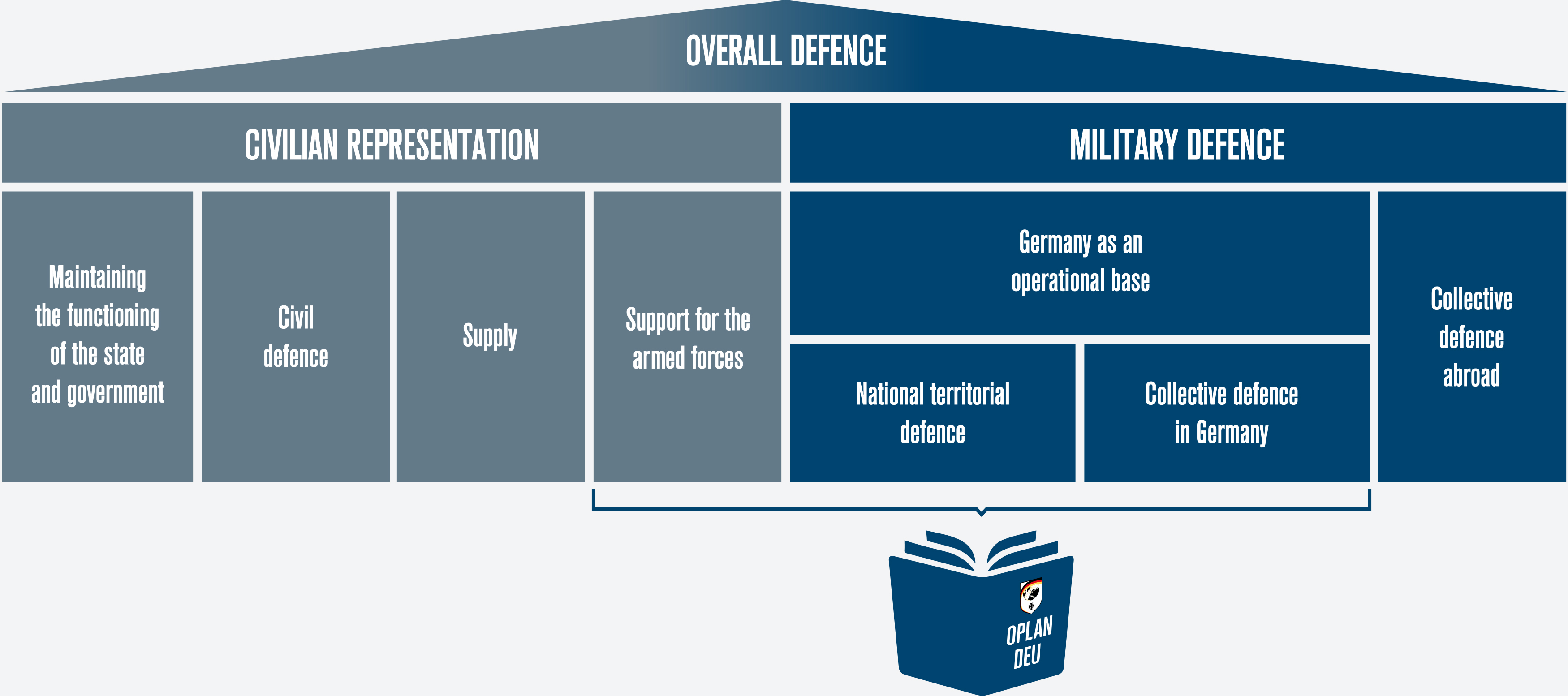
No, the OPLAN DEU only governs the protection of defence-critical infrastructure. Defence-critical infrastructure includes all structures that the armed forces need for military mission accomplishment and national defence. Critical infrastructure is a broader concept. Protecting it is a joint task for the federal government, federal states, municipalities and relevant companies. The latter have the primary responsibility, but work closely together with government agencies. Nevertheless, effective establishment of critical infrastructure – especially in times of worsening security situations – is closely linked to the functioning of military defence and is the basis of our country’s security, which is why it is the subject of ongoing interministerial discussions.
In future, the Bundeswehr will plan and conduct its operations at home and abroad from a single command in Berlin and Schwielowsee.