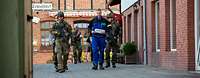
Close protection by the Bundeswehr Military Police
Persons at a particular risk require particular protection. This also applies to field units. During duty hours, senior commanders, the chiefs of service, the Chief of Defence, and their deputies are therefore accompanied by specially trained members of the Bundeswehr military police, the close protection personnel.
Close protection personnel are also known as personal security details according to their task of ensuring the personal security of the person to be protected from attacks staged by third parties. Attacks may include kidnappings, assassinations, or assault. From a military perspective, persons to be protected include, for example, the commanders of missions or important brigade-size units or higher. The Bundeswehr's most prominent person requiring protection is the Chief of Defence. It is the military police’s task to ensure his security and that of similarly important persons in the military environment. The specially qualified military police servicemen and women also preserve the physical integrity of high-ranking military personnel – such as contingent commanders – of friendly or allied armed forces within the scope of visits or combined international operations.
Special task – special capabilities
Driver training on various vehicles is essential for military police close-protection personnel
Bundeswehr/Björn Kapfer
Military police close protection personnel adhere to similar operational principles as their civilian police counterparts. In addition to self-defence techniques, the servicemen and women learn how to drive armoured limousines and protected military vehicles such as the EAGLE. They usually move in the immediate, closest vicinity of the protected person. If several close protection personnel are employed at the same time, precise coordination is of the essence. Their main task is to identify dangers for the person they protect and ward them off. For the military police, this mission may also be connected to military operations. Example scenarios include the escorting of a person to be protected while moving between two locations or deploying to a command post.