The Allied Joint Support and Enabling Command (JSEC) in Ulm is responsible for enabling rapid troop and equipment transports in Europe. JSEC is led by NATO, while the German contingent is organizationally part of the Bundeswehr support operations.
JSEC prepares plans for different situations and coordinates the support provided by NATO forces to ensure that multinational forces in Europe can be moved quickly and safely to their destination in the event of an Article 5 contingency.
There are three operational-level commands in the NATO command structure. Known as Joint Force Commands (JFC), they comprise JFC Brunssum in the Netherlands, JFC Naples in Italy and JFC Norfolk on the east coast of the United States. They are responsible for Alliance defence in different regions. JSEC ensures that the military capabilities provided by NATO countries are available in the respective employment areas in sufficient time to provide the operational headquarters with the best possible support. In cases where several nations wish to take the same route across European Alliance territory at the same time, JSEC will prioritise and decide in accordance with military requirements. Such decisions are based on NATO defence planning.
What does this have to do with Germany?
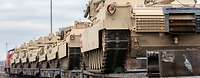
Due to its central geographical location in Europe, Germany’s role is of great importance. While soldiers are generally deployed to their employment area by aircraft, battle tanks, armoured infantry fighting vehicles (AIFV), command vehicles, transport vehicles, and other equipment and materiel containers are mainly transported by ship or rail. If at all possible, commanders try to avoid road movements over long distances due to the considerable strain on both personnel and materiel. Should rail or waterborne transport capacities prove insufficient, however, movements by road will often be the last remaining option for taking troops to their theatre of operations. In this capacity, Germany acts as a central hub for allied forces through which both materiel and troops can be distributed to their final destination, e.g. NATO’s eastern flank.
Transatlantic and across Europe: In crisis situations, troops and materiel have to be transported quickly and efficiently to their theatre of operations.
Bundeswehr/Susanne Hähnel
Support from a single source
Germany’s central location in Europe is essential for JSEC. In an Article 5 contingency, up to 800,000 soldiers from NATO forces and their weapon systems and materiel have to be transported to NATO’s external borders within 180 days, and provided with supplies while transiting through Germany. JSEC coordinates all movements of troops and materiel in and across Germany with the Bundeswehr Joint Force Command (BwJFC), which serves as JSEC’s point of contact in Germany. In case of an emergency at NATO’s eastern flank, however, this is not enough. Since JSEC’s responsibility extends throughout Europe, it does not only coordinate troop movements with the BwJFC in Germany, but also with all other competent commands in the respective European countries – a huge planning task for JSEC.
Mobile, just as the force itself: JSEC ensures flexible command structures and operational readiness.