
Interview
More
Ukrainian Trench Fighter Tells His Story
Ukrainian Soldier Taras W. is trained in trench warfare by Bundeswehr soldiers – and shares his experience of fighting against drones.




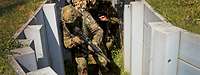
Positional warfare in Ukraine: Racing against time, whoever masters trench warfare and drones equally well has the best chance of victory.
A shrill buzzing shatters the deceptive silence. A small Ukrainian drone carrying 500 grams of explosives has identified the enemy target: a trench deep in the forest, protected by barbed wire and covered with foliage. But there is a gap in the camouflage through which a rifle protrudes. The drone races towards the gap in the trench at 80 kilometres per hour, its razor-sharp rotors cutting through every branch across its path. All the rifles in the trench turn towards the drone. The soldiers open fire. Who will be faster?
From just 100 metres away, the Ukrainian squad leader, Non-Commissioned Officer Taras W., watches the scene. The enemy has revealed its position through the rifle fire. Taras W. now gives his comrades brief final instructions for the engagement. Earlier, he had marked both the enemy’s positions and their own positions on the ground with crosses drawn in the sand. Together, the soldiers had discussed how to surround the enemy from different sides and thereby cut them off from supplies. “The assault team and the covering team split into small groups of two”, orders Non-Commissioned Officer Taras W. to his comrades. Any larger gathering of people is a worthwhile target that hostile drone pilots immediately single out.
After the order is given, everything has to happen quickly. In trench warfare, speed and precise coordination are essential. The German instructor, Captain Konstantin W., observes every movement of the Ukrainian soldiers. If necessary, he gives additional instructions to the troops. A soldier who translates from German into Ukrainian is available to assist him. Under the cover of a smoke grenade, the Ukrainian assault team now launches its attack on the enemy trench. In the background, the covering team is in position and provides fire support to protect its comrades. The Ukrainian soldiers advance and fight their way free through one dark trench branch after another. They then secure the trench system and its surroundings in small groups, so that the enemy cannot recapture them.
What other soldiers train for several months in peacetime is carried out here, at a German military training area, in half the time. The location is secret. Alongside the tactical treatment of wounded personnel and combat in wooded terrain, trench warfare training is an important part of the accelerated training programme for squad leaders. In the fifth year of Russia’s full-scale invasion of Ukraine, the front lines have hardened and the ongoing fighting has developed into a fully-fledged war of position.
At the same time, both sides are trying not only to hold territory but also to expand their positions. “That is why trench warfare is actually taking place on a daily basis in Ukraine,” explains Captain Konstantin W. However, the so-called transparent battlefield, in which no troop movement can go undetected by satellites, radar or reconnaissance drones, does not make soldiers redundant in combat. A drone’s capabilities alone are not sufficient to capture and hold a position permanently, the captain says. “A drone cannot open a door. People still have to fight their way into a position.”
“Trench warfare is already very complex in itself”, emphasizes the German captain. “Above all, however, the modern interaction between technology and soldiers is completely new.” Traditional elements of trench warfare, such as the assault team and the covering team, as well as their coordination – in other words, clear communication – are indispensable. “The situation, the intention and the individual tasks - a great deal has to be communicated by orders.” This is because, particularly in unfamiliar terrain, fire and movement must be closely coordinated. Accordingly, the covering team only opens fire on the trench section under attack on the squad leader’s command. This keeps the enemy pinned down while the assault team attacks.

High-tech at the front: Small, manoeuvrable drones are used for reconnaissance and attacks. At a top speed of 80 kilometres per hour and with 500 grams of explosives, nothing and no one is safe from them.
Bundeswehr
War of position: In the fifth year of Russia’s war of aggression against Ukraine, there is little movement at the front. The soldiers fight not only in small trenches, but also in entire bunker systems, in order to hold as many villages as possible.
Bundeswehr
A picture stays in the memory better than words: The squad leader has marked the enemy positions on the forest floor and is discussing with his comrades how to encircle the enemy and cut them off from supplies.
Bundeswehr
An ambush may be waiting around every bend: Trenches are often complex and branching. One bend after the other has to be cleared. Fixed trench systems such as this one are designed for positional warfare, which often lasts several weeks.
Bundeswehr
Under cover of smoke: The assault team often throws smoke grenades to conceal itself from the enemy and capture enemy trenches. The soldiers then point their machine guns at the positions, while the covering team provides fire support.
Bundeswehr
Learning from one another: In this safe environment, Ukrainian soldiers can practise with their German instructors as often as they wish how to clear a trench. At the same time, they explain the use of drones in combat to Bundeswehr personnel.
Bundeswehr
Every small movement could be suspicious: After capturing a trench, thorough security measures are essential. This also includes careful, round-the-clock surveillance. The sentry must be able to identify enemy scouts at a moment’s notice.
Bundeswehr
Beware of booby traps: Assessing the terrain also plays an important role in the training of Ukrainian trench fighters. Booby traps are used to cordon off captured areas and prevent enemy troops from advancing.
BundeswehrCorrectly assessing the terrain also plays a major role. Where might an enemy be hiding? Which terrain could be used for an attack? Where is there protection from enemy fire? In addition, soldiers must assess where mines might be located. These are used to block off areas and prevent enemy troops from advancing. They are usually placed where a person is expected to step, for example in cleared paths through undergrowth or along well-trodden tracks. “In the war in Ukraine, there is no place where you do not have to expect mines or booby traps,” warns the captain.
However, today’s battlefield is made even more complex by the use of drones. “In the past, people simply fought man against man. But drones are much more inhumane – and yet, paradoxically, they also save lives at the same time,” says the German instructor. On the one hand, interceptor drones can repel various attacks from the air, thereby protecting both soldiers and civilians. On the other hand, drones are used both for reconnaissance and for attacks, including the dropping of explosives and grenades. This makes the entire engagement more dangerous and unpredictable.
So-called first-person-view drones, controlled by the drone operator using a VR headset, for example, search a covered trench for a gap and fly directly into it – regardless of whether it is a 1,5-metre-deep trench, an anti-tank-ditch or an entire underground bunker system. “Drones are almost made for trench warfare”, concludes Captain Konstantin W.
Ukrainian Soldier Taras W. is trained in trench warfare by Bundeswehr soldiers – and shares his experience of fighting against drones.
In addition, the Ukrainian squad leader, Non-Commissioned Officer Taras W., emphasises the importance of exchanging trench warfare tactics and methods. “For example, just an hour ago I showed a German comrade how to protect yourself against drones,’” says the Ukrainian NCO. The use of drones has fundamentally changed the fighting in Ukraine, both in reconnaissance and in attacks. At the same time, soldiers must know how to defend themselves quickly. “That is why I explained how to protect our positions when drones attack – for that is the most difficult thing of all,” explains NCO Taras W.
The lessons learned by the Bundeswehr through its support for Ukrainian service personnel feed directly into the training of German forces – including, among other things, efforts to strengthen the 45th Armoured Brigade in Lithuania. “We must do everything we can to prevent another war. This is what our training support in the context of EUMAM Ukraine contributes to,” says Captain Konstantin W., adding: “What the Ukrainian soldiers experience and describe to us here is something no one else should ever have to experience.”
*All names have been changed for the protection of the soldiers.


