
Risk and crisis management
Prevention and response: crisis management for German nationals abroad
The Bundeswehr also protects German nationals outside Germany – with crisis prevention and management.




Whether there is a civil war or a natural disaster – there are countless reasons why a country may no longer be safe. When foreign nationals run into danger there, their home country becomes responsible for bringing them back home. If a noncombatant evacuation operation is necessary, the Bundeswehr rescues German citizens.
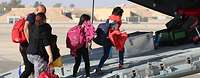
Terrorist attacks, violent unrest, earthquakes or pandemics: when German citizens find themselves in crisis situations abroad, the Bundeswehr assists the Federal Foreign Office by conducting an evacuation operation to bring them back to German territory or to a safe third country. Evacuation is a national responsibility. However, friendly nations often work together on evacuations in order to bring as many people as possible to safety.
There are two forms of evacuation: unarmed evacuation of German nationals, also known as diplomatic pick-ups, and military evacuation operations, also known as noncombatant evacuation operations (NEOs), in which armed force may be used to protect German nationals.
Diplomatic pick-ups are generally conducted without armed forces, for example if there is a supply shortage in the country. In such cases, the Federal Foreign Office decides whether to evacuate German nationals. Civilian transport companies such as airlines are often tasked with this. However, the Federal Foreign Office may also request aircraft from the Special Air Mission Wing at the Federal Ministry of Defence as administrative assistance. One example of a recent unarmed evacuation of German nationals was the coronavirus pandemic: at the beginning of it, German nationals were flown out of Wuhan, China without deployment of armed forces.
If the situation deteriorates in a crisis area, the Bundeswehr provides support in the form of military forces – to protect citizens requiring evacuation as well as military personnel in the task force. As these noncombatant evacuation operations are considered deployment of armed Bundeswehr forces, they are subject to parliamentary approval. This means that the German Bundestag must first grant its approval in accordance with Article 87a of the Basic Law for the Federal Republic of Germany, provided there is no imminent danger. If there is, approval is granted at a later date.
An example of a noncombatant evacuation operation: When civil war broke out in Sudan in 2023, German nationals were in the crisis region and unable to leave it because airlines had stopped all flights. The Bundeswehr then evacuated Germans, as well as citizens of other countries requiring protection, from Sudan.
If the German government’s crisis management team decides in favour of a noncombatant evacuation operation, the Federal Ministry of Defence becomes responsible for conducting it. The Bundeswehr Joint Force Command, which is directly subordinate to the ministry, handles planning and conduct of a noncombatant evacuation operation. The task force’s size and equipment depend on the mission and the security situation in the mission country. Noncombatant evacuation operations are divided into rapid and robust evacuations.

In a rapid evacuation, German citizens are rescued by sea or by air. The focus is on getting as many people as possible out of the crisis region to safety as quickly as possible. This requires an evacuation point located in the safest environment possible within the crisis area, generally an airport or seaport.
In a rapid air evacuation, depending on the distance from the crisis country, the aircraft coming to rescue people take off either directly from Germany or from a host country nearby. Alongside the German Air Force, the task force on site in the mission country plays a key role. Paratroopers, military police and medical forces work hand in hand in this task force. After an aircraft lands, they secure the airport and prevent potential troublemakers from damaging the aircraft or gaining unauthorised access. Military police register the evacuees. Medical forces treat any injuries or wounds. When everyone is safely on board, they are brought back to Germany, either directly or with a stopover in the host country.
If there is a coast nearby, a rapid evacuation can also be conducted by sea. This depends on whether a vessel from the German Navy or a NATO unit is in the waters near the crisis area, because transit from Germany to the crisis country would generally take too long. The unit for rapid sea evacuation, comprised of snipers, military police and medical forces, is formed by the Shore Force Protection Company of the Sea Battalion in Eckernförde.
If there is a safe port in the crisis country that can serve as an evacuation point, German Navy personnel will sail there to take evacuees on board. If there is not, the ship will drop anchor at a safe distance. The evacuees will then be brought from land to the ship by boat. The naval forces safeguard the ship and the evacuees.

When evacuation operations are conducted over long distances, endangered citizens are initially taken to a safe third country in a military aircraft, as seen here on the way to Jordan during the 2023 evacuation from Sudan.
Bundeswehr/Hultgren
Rescuing hostages can also be part of noncombatant evacuation operations. Special Operations Forces Command personnel regularly practise these measures in exercises.
Bundeswehr/KSKIdeally, evacuees should make their own way to the evacuation point within the crisis area. However, if the situation in the crisis country is so dangerous that this is no longer possible, a robust evacuation is conducted. This term refers to the robustness of the unit. This means that, in the worst-case scenario, Bundeswehr troops will clear the route to the citizens in need of protection in order to bring them out of the crisis area.
The task force in a robust evacuation very quickly sets up a military base, including a mobile surgical hospital, in a safe third country. Depending on the distance, troops fly or drive from there to the crisis area to collect the evacuees. They bring the people being protected along evacuation routes to evacuation points such as airports or seaports, which may also be located in a neighbouring country, depending on the threat situation. Once they have crossed the border, responsibility for conducting the evacuation and further recovery transfers from the Federal Ministry of Defence back to the Federal Foreign Office.
Robust evacuation operations may also entail limited rescue and recovery missions. These missions may be necessary either if the task force’s own forces become isolated or, in some circumstances, if German nationals are unable to make their own way to the designated assembly point. In these cases, forces from the evacuation operation task force or multinational partners may conduct a limited rescue and recovery operation. Hostage release operations during an evacuation operation, in which hostages and abducted citizens are freed, are a task for special operations forces.
What are evacuation operations, how are they conducted and who frees German hostages? Questions and answers about the Bundeswehr evacuating German nationals:
Evacuation operations is an umbrella term for all measures taken by the Federal Republic of Germany to pick up or rescue threatened civilian nationals from a crisis area abroad and bring them to a safe third country or back to Germany. The Federal Foreign Office is in charge of evacuation operations. They are initiated by the German government’s crisis management team. Responsibility for conducting them transfers to the Federal Ministry of Defence when they are noncombatant evacuation operations.
The Bundeswehr provides aircraft and ships for diplomatic pick-ups (unarmed evacuation) of German citizens through administrative assistance and disaster relief in accordance with Article 35 of the Basic Law. For dangerous situations requiring noncombatant evacuation operations (robust evacuations), the Bundeswehr keeps mission-ready military forces capable of evacuating, rescuing and freeing endangered Germans from crisis areas ready at all times. The German Bundestag decides whether to deploy these forces.
Evacuation generally takes place from an evacuation point. This is usually an airfield and/or a seaport. From this point, endangered citizens are brought to a safe environment. Ideally, the evacuees make their own way to an assembly point. Here, they are registered and brought to the airport or seaport together. The next destination is a safe refuge – depending on the crisis situation and the distance, either somewhere temporary within the crisis country or in a safe third country that cooperates with Germany. It is also possible to evacuate them directly to Germany.
Evacuations generally take place from a certain pick-up or assembly point, from which endangered citizens are brought to an airport or seaport together. This assembly point is designated by the German missions abroad. If German nationals are unable to make their own way to the designated location – for instance, due to a fuel shortage, a lack of vehicles or combat action along their route – troops from the German task force of the noncombatant evacuation operation can rescue them and bring them to the pick-up point. These operations usually involve special operations forces. If nationals of more than one country are isolated, the military forces of friendly nations may also pick them up.
Unlike crisis prevention teams, the Bundeswehr’s crisis support teams are deployed directly in conflict phases. The German government’s crisis management team makes an interministerial decision on whether to deploy them to a crisis region. In addition to the Bundeswehr, the Federal Foreign Office and the Federal Police also provide personnel for crisis support teams.
Crisis support teams are tasked with advising and supporting the German missions abroad in preparing and conducting evacuation operations or other measures related to crisis management. They ascertain the current situation on site in order to provide information about the scope of military assistance needed. Military support varies depending on the threat situation, ranging from providing transport capabilities to a robust combat mission. Crisis support teams are deployed on site to support the German mission abroad in the crisis country. They are comprised of military personnel as well as civilian experts who have been specially trained for this mission and regularly exercise evacuation scenarios. They work in civilian clothing and are unarmed.
The German government decides whether to conduct a hostage rescue operation. Even when conducted in parallel with a noncombatant evacuation operation, operations to free hostages are conducted independently and separately by Bundeswehr special operations forces.
Evacuations bring German nationals out of crisis regions to a safe third country or to Germany. Depending on the threat situation, evacuations use civilian aircraft or ships, or military transportation provided by the Bundeswehr as administrative assistance in accordance with Article 35 of the Basic Law or in a noncombatant evacuation operation with armed forces.
If endangered citizens are isolated, Bundeswehr special operations forces or specialised forces can be deployed for rescue and recovery. This may be the case if, for example, combat action in the affected citizens’ immediate vicinity makes it impossible for them to make their own way to an assembly point. These rescue operations are known as personnel recovery operations within the framework of noncombatant evacuation operations.
Personnel recovery generally refers to independent operations to rescue and recover isolated personnel who have been cut off from all connections. They could be not only German military personnel but also civilian personnel working in a crisis region for the Federal Republic of Germany. Personnel recovery operations may also be conducted to protect important or sensitive equipment with security-relevant information from being accessed by the enemy.
