
Evacuation operations
How the Bundeswehr rescues Germans from crisis regions
Whether there is a civil war, natural disaster or some other crisis: when Germans abroad are in danger, the Bundeswehr will bring them to safety.




It is a core mission of the Bundeswehr: National risk and crisis management serves to protect German nationals abroad – by preparing for and managing crises, and even by military means if necessary.
When a conflict escalates, a war breaks out or a natural disaster disrupts travel routes, the Bundeswehr assists the Federal Foreign Office in bringing German nationals back to Germany or to a safe third country. The Federal Foreign Office is in charge of crisis management for German nationals abroad, but the Bundeswehr is responsible for conducting noncombatant evacuation operations (NEOs), also known as military evacuation operations. National risk and crisis management is therefore anchored as an ongoing task in the Bundeswehr Joint Force Command.
Crisis management for German nationals abroad involves crisis prevention and crisis response. Prevention measures are mainly taken outside of acute conflict phases. Under the direction of the Federal Foreign Office, interministerial crisis prevention teams are regularly sent to the German missions abroad to gather information for potential evacuations: How is the mission abroad staffed? What crisis plans are there? Where are hospitals and critical infrastructure located? What is the quickest way to reach the aerodrome? This includes transport routes and alternative routes if streets, ports or airports have been destroyed in a conflict. How many people actually have to be evacuated in an emergency and where are they located?
The data collected lays the foundation for country-specific contingency planning. This specifies what civilian and military capabilities are required for an evacuation according to the escalation level and the type of evacuation. All the information is recorded in a database and regularly updated. Evacuation operations are generally prepared on an interministerial basis. Besides the Federal Foreign Office, the Federal Police and the Bundeswehr are also always involved in the planning. Multinational arrangements are also made.
The crisis prevention teams are also tasked with advising and training the local personnel. This is intended to strengthen the resilience of the German missions abroad and their ability to take action when crises develop.

Crisis support team employees register German nationals and other endangered people at an assembly point; in this case, as part of the SCHNELLER ADLER evacuation exercise.
Bundeswehr/Jana Neumann
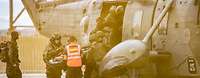
Evacuations are also conducted by sea when a port is close enough. Ships from the German Navy or multinational partners deployed in maritime areas can then bring the endangered citizens of various countries to safety (pictured).
Bundeswehr/Mario BährWhen a conflict breaks out in a crisis region or a situation escalates, the German government’s crisis management team decides whether to evacuate German nationals. Evacuations comprise all the measures required to rescue German citizens and bring them to a safe third country or to Germany. These range from basic recovery with civilian or military transportation to hostage rescues by Bundeswehr special operations forces. The German Bundestag must always approve the use of military force to evacuate or rescue endangered citizens; approval may be granted at a later date, however, for especially dangerous situations.
If military support is required, the Bundeswehr deploys crisis support teams to the German missions abroad in the crisis country and, if necessary, to neighbouring states. They prepare the military evacuation operations on site. The size and make-up of the crisis support teams vary, depending on the type of crisis, its intensity and the measures it requires.
It is important to note that, as a general rule, every country is responsible for evacuating its own nationals when they are in danger. Often, however, multinational arrangements are necessary – for example, when ports or airports have been destroyed or cannot be used for some other reason. In these instances, the countries involved determine who can use what infrastructure and when. It is also common for citizens from several countries to be flown out together to make optimal use of rescue resources.
When does the Bundeswehr rescue people from crisis regions? Who makes decisions on this and who pays for it? Questions and answers about crisis management for German nationals abroad and evacuating German nationals.
The Federal Foreign Office is the ministry in charge of crisis management for German nationals abroad. Each year, in coordination with the Federal Ministry of Defence, the Federal Ministry of the Interior and the Federal Ministry for Economic Cooperation and Development, it sends crisis prevention teams to the German missions abroad in countries with current or potentially developing crises.
The teams are interministerial, with from personnel from the Federal Foreign Office, the Federal Police and the Bundeswehr. On site, the teams check crisis plans and options for action. They advise the missions abroad about potential crisis situations and train personnel on site. They also gather and analyse data to provide a basis for potential evacuation operations. This includes, for instance, the number and potential whereabouts of nationals requiring evacuation, assembly points, means of transport and transport routes. In addition, the teams identify options for multinational cooperation.
Contingency plans are drawn up for countries in which it seems possible a crisis will develop. They are intended to make preparations in as much detail as possible for the event that evacuation becomes necessary, and also to illustrate various options for action, for example if airports have been destroyed, making pick-up by aircraft impossible so that people have to be evacuated by land or sea instead.
Every five to eight years, in order to maintain the most up-to-date data possible on which to base their operations, the crisis prevention teams from the Federal Foreign Office, the Bundeswehr and the Federal Police visit nearly every country outside Europe where evacuation operations could become necessary. Consequently, planners are able to access data that is no more than eight years old in case of an emergency. In a best-case scenario, the data was just collected the year before – as was the case for the evacuation operation from Sudan in 2023. A crisis prevention team had been in the country shortly before the evacuation.
When German citizens abroad are in danger due to conflicts or crises, the German government’s crisis management team decides whether to evacuate them. The Federal Foreign Office always has lead responsibility. It is responsible for and coordinates all measures related to civilian crisis management. If a noncombatant evacuation operation becomes necessary due to an escalating situation in a crisis area, such as a civil war breaking out, the Federal Ministry of Defence assumes responsibility for conducting the operation. Generally, all evacuation operations are prepared on an interministerial basis, conducted under national responsibility and, depending on the situation, coordinated at a multinational level.
As a general rule, German nationals can only be evacuated on a voluntary basis. Anyone who does not wish to be evacuated may remain in the crisis region. This may apply to employees of relief organisations, for example. A special regulation applies to civil servants and other personnel sent abroad by government institutions: Their evacuation is not optional. They are obliged to leave the crisis country when so instructed by the German government’s crisis management team.
The Federal Republic of Germany initially covers the costs of an evacuation initiated by the German government’s crisis management team. This means that everyone is rescued from a crisis region who wishes to leave the country. No one has to pay for their evacuation on site. However, in accordance with Section 6(2) of the Consular Law, the evacuees are generally obliged to pay back part of the costs.
Evacuation operations include all measures taken to bring German nationals out of a crisis country to a safe environment. The Federal Foreign Office always has lead responsibility.
Evacuations are divided into unarmed evacuations of German nationals and robust evacuations. Unarmed evacuations are also referred to as diplomatic pick-ups. They involve flying German nationals out of the crisis region using civilian airlines or even Bundeswehr aircraft. In such cases, the Bundeswehr is deployed through administrative assistance in accordance with Article 35 of the Basic Law for the Federal Republic of Germany. One example of a recent unarmed evacuation of German nationals was during the coronavirus pandemic: at the start of the pandemic, German nationals were flown out of Wuhan in China.
Robust evacuations are noncombatant evacuation operations. They are required when an escalation renders a diplomatic pick-up from a crisis region too dangerous and necessitates the deployment of armed forces. In accordance with Article 87a of the Basic Law, the German Bundestag must grant its approval for the deployment of armed forces, provided there is no imminent danger. If necessary, approval is granted at a later date.
