
Risk and crisis management




Kabul, Sudan, Israel: Rescuing German nationals abroad from isolation and crisis situations is a permanent task of the Bundeswehr. Military forces are ready and available at all times for evacuation operations. During the Extricate Owl 2025 command post exercise, three weeks were spent exercising the detailed planning and execution of such operations in the Bundeswehr Joint Force Command.
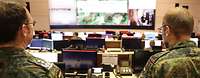
From 3 to 20 November 2025, all stages in the process of a complex evacuation operation were planned out as part of Extricate Owl 2025. The exercise for the first time featured a real-world country being used as the basis for a fictitious exercise scenario. Nigeria was chosen, not due to any current events, but rather to provide a realistic yet hypothetical framework for a crisis management exercise.
The exercise planning produced a challenging simulated scenario: A coup against the government, attacks by Islamist terrorist groups and separatist activities lead to a confusing and increasingly escalating security situation. The scenario includes a large number of Germans wishing to leave the country, as well as other persons requiring protection – mostly nationals of other European countries with no options for evacuating themselves. The exercise assumes that more than 4,300 persons are registered with the Federal Foreign Office, which is in charge of unarmed evacuations of German citizens.
“Exercises are not an end in themselves. Things could get serious next month, next week, or even tomorrow – then the troops will be on their way”, says Colonel (GS) Thomas G., who is in charge of exercise control on Extricate Owl 2025. He explains that a non-fictitious country provides more realistic options for exercises than a purely hypothetical crisis region – with real consular interfaces, real distances and more realistic threat situations.
The mission begins with the Federal Foreign Office issuing a recommendation to leave the crisis country. Germans choosing to leave the country ahead of time are evacuated on civilian flights. In this context, the Bundeswehr assists the Federal Foreign Office with crisis support teams (CST) consisting of unarmed military personnel in civilian clothing. A total of around 1,000 people leave the crisis country this way. However, due to increasing escalation, international airports and seaports are also affected by the unrest. Foreign nationals are no longer able to leave the country.
In the days that follow, there are only limited time windows, even for official unarmed evacuations. The Bundeswehr receives the order from the German government’s crisis management team to rapidly evacuate German nationals by sea and air. Due to good diplomatic relations and logistic capacities, the exercise units choose Ghana as a safe host country and logistic hub. The distances are substantial, however – the return trip to Lagos in Nigeria is 38 hours via the sea route. The aerial route involves flying over Togo and Benin. Nevertheless, more than 2,900 people are successfully evacuated using a combat support ship of the German Navy and A400M transport aircraft of the German Air Force.

Advice and organisation: Military personnel – unarmed and in civilian clothing – support Germany’s diplomatic missions abroad with evacuation operations in interministerial crisis support teams, in this case as part of the noncombatant evacuation …
Bundeswehr/Jana NeumannIn the scenario, a French Navy ship brings another 846 people to safety. A total of seven partner nations were integrated into Extricate Owl 2025. Because even in an emergency, the Bundeswehr never operates alone in any crisis country. According to Colonel (GS) Stephan T., who has been chief of the evacuation operations staff for past evacuations and also during the exercise: “Evacuation operations are commanded at the national level but always coordinated at a multinational level. Because in a real emergency, just like in training, the goal is to make the best possible use of scarce resources.”
If there is only one berth available at the port, the nations participating in the evacuation coordinate which ship can take the most people on board. If one country has been allocated a slot at the airport that it is unable to use, the slot is exchanged with another country if possible. “Each country wants to bring its own nationals to safety as quickly as possible. That’s what brings them together”, says Stephan T.
As the conflict intensifies, with hostilities between the opposing sides, violent attacks against the civilian population and flows of refugees, the people requiring evacuation are eventually no longer able to move safely within the country. At the same time, increasing numbers of locals and their families try to gain access to the assembly points intended for the evacuation of foreign nationals.
Following a decision by the crisis management team, a robust noncombatant evacuation operation is launched, in which armed force may be used to protect German citizens. In this instance, a mandate is required for the deployment of armed forces. However, approval may be granted by the German Bundestag at a later date in the event of imminent danger. Protected by armed German soldiers, people are then allowed to be brought to the evacuation points and subsequently moved out of the country.
“The robust evacuation operation is the most complex and demanding form of military evacuation”, explains Colonel Stephan T. It requires a seamless collaborative interaction between forces on land, at sea and in the air – with a potential task force of up to 1,000 military personnel.

The task force for a military evacuation operation may comprise up to 1,000 military personnel from the Army, Air Force and Navy as well as the Bundeswehr Joint Support Command. The picture shows specialised forces in Jordan during the noncombatant …
Bundeswehr/Andreas Hultgren
The aim of military evacuation operations is always to bring own nationals and other persons entitled to protection to safety as quickly as possible. The picture shows an evacuation flight from Sudan in April 2023.
Bundeswehr/Jana NeumannThe exercise activities also cover isolated situations, in which the people affected are no longer able to rescue themselves by their own efforts. In the scenario, four Federal Police officers have remained in the capital to protect the German embassy and must now leave the country via land routes.
“Isolation situations are always time-critical. Even when there is no direct danger to life and limb, they can quickly develop into kidnapping or hostage taking situations”, says Stephan T. Speed is therefore the key to success. “In the scenario, it would take longer to fly in forces specialised in personnel recovery from Ghana than to send the paratroop company that is already on site to protect the airport for the air evacuation”, the Colonel explains.
The Extricate Owl exercise series is a command post exercise that does not involve an actual deployment of forces or any specific connection to operations. The exercise focuses on the operations staff for an evacuation operation. Most of the Bundeswehr’s military and civilian personnel involved are from the Bundeswehr Joint Force Command.
When the operations staff is alerted, the Army, the Rapid Forces Division, the Air Force, the Navy and the Bundeswehr Joint Support Command also contribute forces to the staff. To optimise interministerial cooperation, the Federal Foreign Office and the Federal Police, among others, are also involved in the exercise. This is because they also form part of the operations staff in an emergency.
Crisis situations can escalate at any time, potentially requiring the evacuation of German citizens.
“In 2023, we exercised a military evacuation operation during Extricate Owl. Three weeks later, the exercise participants came together again – this time for a real-world crisis situation, namely the evacuation from Sudan”, says Colonel Stephan T. “The worldwide security situation shows that crisis situations can escalate at any time, potentially requiring the evacuation of German citizens.”
by Simona Boyer
