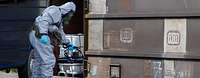
As highly qualified experts, CBRN reconnaissance forces are able to detect and counter the most dangerous chemical, biological, radiological and nuclear substances. Their capabilities significantly contribute to maintaining the units’ freedom of movement and sustainability.
CBRN defence specialists are able to detect chemical, biological, radiological and nuclear agents or comparable hazardous industrial substances, even under adverse operational conditions. With the FUCHS armoured CBRN reconnaissance vehicle, the Bundeswehr Joint Support Command has the state-of-the art system for detecting such substances at its disposal. The crews do not need to get off the vehicle in order to detect radiation and identify all kinds of hazardous substances. For example, the wheeled armoured fighting vehicle features a mobile mass spectrometer, which allows a preliminary analysis of chemical agents. Such agents may include nerve, blister, blood and choking agents. These substances may pose a massive threat to field units.
Sample analysis in mobile laboratories
Within the CBRN reconnaissance forces, the SIBCRA teams (SIBCRA = Sampling and Identification of Biological, Chemical and Radiological Agents) are of particular importance. Specialising in the reconnaissance of chemical, biological, radiological and nuclear agents, they are highly mobile and can be employed just behind the front lines. Among others, pre-enlistment civilian professions include chemical laboratory assistant and biologist. SIBCRA experts often conduct terrain and object reconnaissance on foot while the combat forces secure the terrain against external attacks. The SIBCRA teams collect samples of the relevant substances and analyse them either on site using rapid tests or in mobile laboratories. Thanks to their direct contact to the field units and their capability of quickly achieving reliable results, commanders and other decision-makers can rapidly take decisions in order to be able to quickly avert or counter a threat.
The FUCHS armoured CBRN reconnaissance vehicle features search, detection and measuring equipment and has room for two reconnaissance soldiers. Soil samples can be taken from inside the vehicle through a flap at the rear end.
Bundeswehr/Alyssa Bier
A reconnaissance soldier of the CBRN defence forces shows how to collect, document and pack a sample
Bundeswehr/Susanne Hähnel
CBRN reconnaissance forces work at the highest international level. During regular exercises, they exchange knowledge and views with specialists from other nations.