
German Air and Space Force
More
Space Dimension
In the Space Command of Bundeswehr, the German Air and Space Force bundles tasks for the coordinated operation, protection, and defense of space systems.


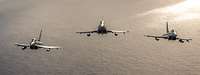
The German Air and Space Force protects Germany from the ground to the space.
The German Air and Space Force is responsible for securing and protecting German airspace, protecting and defending space infrastructure and conducting the air transport of troops, equipment and cargo. The Bundeswehr’s second-largest service supports ground forces from the air, conducts air rescue missions, prepares and assesses the space situation picture, provides space support to operations in close cooperation with the German Cyber and Information Domain Service Headquarters and executes space operations.
When we talk about the German Air and Space Force being ready for deployment, we are talking about air power. Because we protect Germany from the ground all the way into space.
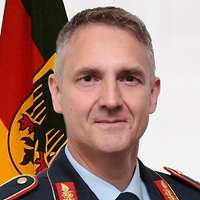
“Our mission is clear: we must be able to monitor and protect both German and NATO airspace, as well as space, against attacks at all times.”
The mission of the German Air and Space Force is to conduct air sovereignty tasks even in peacetime. It keeps German airspace under surveillance by means of control and reporting centres, also known as tactical air command and control groups, and maintains responsive combat aircraft formations. This also includes the protection against airborne threats such as rockets, unmanned aerial vehicles and cruise missiles, as well as the protection and defence of Germany’s own space systems.
The German Air and Space Force ensures the personnel and materiel readiness of the Bundeswehr and participates in assistance, rescue and evacuation operations in Germany and abroad.
The German Air and Space Force also contributes to military stability in Europe by participating in:
In crises, the German Air and Space Force flexibly adapts its operational readiness to situations as they evolve. It works closely with other Bundeswehr services and the forces of allied nations to help manage armed conflicts. The primary objective of these efforts is always to protect the population and vital infrastructure, maintain territorial integrity and ensure Germany’s political freedom of action. Space is a critical field of action for security and defence systems and shapes the operational capability of the German Air and Space Force.
The German Air and Space Force is therefore responsible for multiple domains – from the ground to outer space. The Bundeswehr Space Command is where the German Air and Space Force pools its space domain capabilities and ensures the standing operational task of military use of space is performed.
The German Air and Space Force is under the command of the Chief of the German Air and Space Force. Lieutenant General Holger Neumann has held this office since May 2025. The German Air Force Headquarters falls under his purview.

Lieutenant General Holger Neumann
German Armed Forces/German Air and Space ForceThe predominant colour of the German Air and Space Force is blue. So it should come as no surprise that the uniforms are of a rich blue as well.

Caption: Side cap and belt: this is the Air Force dress uniform. It is mostly worn for formal events such as the pledge ceremony.
German Armed Forces/Sebastian WilkeThe typical headwear is the Air and Space Force side cap. In the past, all services of the Bundeswehr issued side caps. Today, however, nearly everyone who serves in the German Army wears a beret. The German Air and Space Force has retained this traditional part of its uniform. Only infantry formations such as the German Air and Space Force Force Protection Regiment have made the switch to berets, which, however, remain blue – true to the original style. German Air Force members also wear the Bundeswehr field uniform in camouflage green. The only difference between the German Air and Space Force field uniform and that of the other services is the German Air and Space Force wing adorning the rank insignia. You may also spot flight overalls for pilots and mechanics’ coveralls for technicians in the German Air and Space Force.
The German Air and Space Force operates a versatile fleet of combat aircraft, transport aircraft, helicopters and unmanned aircraft systems. The main fighter jet of the German Air and Space Force is the Eurofighter; it is supplemented by the Tornado for reconnaissance and electronic warfare and to ensure nuclear sharing. The F-35 will replace the Tornado in the near future. The Air Force employs the Airbus A400M and the C-130J Super Hercules for air transport. It also participates in the Multinational Multirole Tanker Transport Unit (MMU), which uses the A330 MRTT in its fleet as a refuelling and transport aircraft. The Special Air Mission Wing of the Federal Ministry of Defence ensures government and MedEvac flights using the Airbus A350, Airbus A321 and Bombardier Global 6000 aircraft, among others.
The German Air and Space Force also operates the CH-53 transport helicopter, which will be replaced by the CH-47 Chinook in the next few years. The H145M LUH SOF light support helicopter is deployed for operations with the Special Operations Forces Command. The German Heron TP drone has been in use since the end of 2022, when it received its type certification. This unmanned combat aircraft is primarily intended for gathering intelligence on individuals or objects.
In order to protect German airspace, the German Air and Space Force maintains Quick Reaction Alert (QRA) elements at two different locations. These QRA elements remain ready to respond 24/7. According to NATO requirements, fighter jets and their pilots must always be ready to take off within 15 minutes. 74 Tactical Air Wing from Neuburg an der Donau in Bavaria is responsible for protecting the southern part of Germany. 71 Tactical Air Wing “Richthofen”, which is responsible for protecting the northern part of Germany, is based in Wittmund. Due to construction work at Wittmund, the QRA is temporarily accommodated at 73 Tactical Air Wing “Steinhoff” in Laage.
In addition, the German Air and Space Force takes turns with other nations in supporting NATO missions such as enhanced Air Policing in Romania or Poland to secure airspace on the Alliance’s eastern flank.
Space systems also play a part: for the employment and operation of systems, the Bundeswehr Space Command continuously provides the German Air and Space Force with data, information and products for the standing operational task of military use of space.
Technology plays a prominent role in the German Air and Space Force. Members of this branch of service acquire the special skills required to master this technology at various education and training facilities.
Basic Military Training
Service members begin their careers with basic training, where they learn general military skills. This training is conducted in the German Air and Space Force Training Battalion in Germersheim or Roth. Officer candidates continue their training at the German Air and Space Force Officer School, which relocated to Roth in October 2025. Non-commissioned officer (NCO) and staff sergeant candidates attend a basic NCO course at the German Air and Space Force Non-Commissioned Officer School in Heide.
Special Training
Aircraft engineering, weapons and radar technology are taught at the German Air and Space Force Engineering Training Centre in Faßberg. The German Air and Space Force also operates a training centre in Husum dedicated to the Surface-to-Air-Missile branch. Many more specialised training courses are available, for example for jet pilots, who train in Goodyear and Sheppard in the USA before joining their respective wings.
The German Air and Space Force not only protects the skies. It also has infantry combat specialists, who form the German Air and Space Force Force Protection Regiment “Friesland”. Members of German Air and Space Force Force Protection can even set up, operate and protect an entire airfield in a country of deployment to help ensure airspace security from the ground. The German Air and Space Force Force Protection Regiment also includes rescue and recovery specialists as additional specialised forces. Their mission is to find, rescue and recover both injured or wounded soldiers and civilian employees of the Bundeswehr – soldiers who have been injured or wounded, as well as civilian employees of the Bundeswehr – even behind enemy lines and by using armed force.
Yes, the German Air and Space Force regularly participates in national and international exercises to ensure operational readiness and to strengthen cooperation with our partners. Following successful exercises in the past such as Air Defender and Rapid Pacific, the German Air and Space Force plans on continuing its involvement in a variety of exercises in order to expand its capabilities and deepen cooperation with allied forces.
The German Air and Space Force is the service responsible for the airspace and space domains. The core element in the space domain is the Bundeswehr Space Command in Uedem, which coordinates all German military activities of the Bundeswehr in space. It prepares and assesses the space situation picture and is also responsible for planning and conducting space operations.
The aim is to ensure the safe operation of military space systems, to keep space-based data, services and products available at all times and to reliably protect and defend the space infrastructure of the Bundeswehr and Germany.
The standing operational task of military use of space serves the purpose of national security. To this end, the Space Command closely cooperates with other major military organizational elements, in particular with the Cyber and Information Domain Command Service Headquarters. The focus is on the safe employment, protection and defence of German space systems. The Space Command also issues warnings in case of security-relevant events in space, thereby contributing to the protection of the population based on the Space Security Strategy.
The interministerial Space Situational Awareness Centre also plays a central role. It observes potential dangers to satellites, among other things, and assesses the effects of space weather. The centre also includes a civilian element provided by the Space Agency at the German Aerospace Centre.
The warnings issued by the Space Situational Awareness Centre enable the Bundeswehr, the federal and state authorities and satellite operators to respond quickly and appropriately to space events.
In the Space Command of Bundeswehr, the German Air and Space Force bundles tasks for the coordinated operation, protection, and defense of space systems.
Nearly 28,000 servicemen and women serve in over 50 German Air and Space Force agencies in Germany and abroad. They work at command headquarters, in Tactical Air Wings and air transport units, among other agencies, and are also actively involved in ground-based air defence and force protection.

Almost 28,000 soldiers serve in the German Air and Space Force.

At the moment, German soldiers are deployed in Europe, Asia and Africa, as well as in the Mediterranean.